


FEC historical timeline
The Federal Election Commission was established in 1975 to administer and enforce the Federal Election Campaign Act (the Act). That statute limits the sources and amounts of contributions used to finance federal elections and requires public disclosure of the funds raised and spent.
To document the agency’s history, the Commission has created this interactive timeline that highlights some of the key developments in the agency’s history. Click on the entries that interest you to reveal additional information, including links to related documents and media. Click on a year to expand all entries for that year.
Additional information about the Commission is available on our FEC Mission and History page. If you have questions, please contact the FEC.
-
Revenue Act of 1971
Title VIII, Sec. 802 of the Revenue Act of 1971 (Pub. L. No. 92-178) provided for the establishment of public funding for presidential candidates who agreed to abide by spending limits. The new law allowed citizens to check a box on their tax forms authorizing the federal government to use tax dollars to finance Presidential campaigns in the general election. It did not apply to the 1972 election.
-
Federal Election Campaign Act of 1971
The 1971 Act (Pub. L. No. 92-225) required full reporting of campaign funds raised and spent, and provided legal framework for establishment of separate segregated funds by corporations and labor organizations. It also set expenditure limits on media advertising and set limitations on spending from a candidate's personal funds (both later removed).
-
Federal Election Campaign Act Amendments of 1974

The 1974 Amendments to the Act (Pub. L. No. 93-443) established contribution and expenditure limits for federal candidates and other political committees. It also formally established the FEC and enumerated its responsibilities and duties, which included jurisdiction in civil enforcement matters, authority to write regulations, and responsibility for monitoring compliance. The amendments also made changes to the presidential public funding program, allowing for primary candidates to receive funds and for presidential nominating conventions hosted by political parties to receive funds (Note that the convention funding provision was terminated by the Gabriella Miller Kids First Research Act in 2014).
-
FEC opens its doors
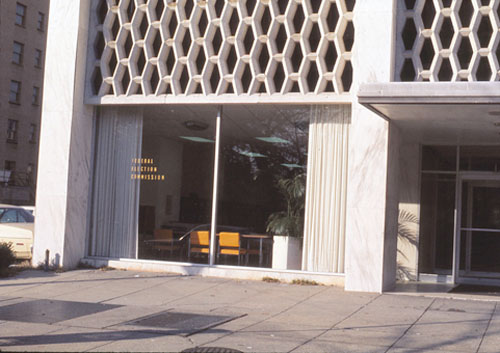
Original FEC building, 1325 K Street, N.W. From 1975-1986, the FEC was located at 1325 K Street, N.W. in Washington, DC.
First Commissioners sworn in at White House ceremony
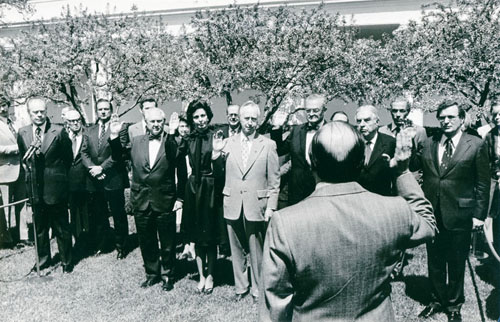
(L to R) President Gerald R. Ford, Commissioners Thomas B. Curtis, Joan D. Aikens, Vernon W. Thomson, Thomas E. Harris, Neil O. Staebler, and Robert O. Tiernan First Commissioners sworn in at White House ceremony. The Commissioners held their first meeting later that day.
Thomas B. Curtis (R) serves as Commissioner -

Commissioner Thomas B. Curtis Commissioner Thomas B. Curtis was the first FEC Chairman. A Republican from Missouri, Mr. Curtis served in the House from 1951-69. He was an unsuccessful candidate for the Senate against Democrat Thomas F. Eagleton in 1968 and 1974. A former vice president and general counsel for the “Encyclopedia Britannica,” Curtis chaired the Federal Rent Advisory Board (1971-73), the Corporation for Public Broadcasting (1972-73) and the Twentieth Century Fund's Task Force on Financing Congressional Campaigns (1970). He graduated from Dartmouth College in 1932 and received his law degree from Washington University in St. Louis in 1935. He was originally appointed for six years.
Neil O. Staebler (D) serves as Commissioner -

Commissioner Neil O. Staebler Commissioner Neil O. Staebler was the Commission's first Vice Chairman. Mr. Staebler was formerly chairman of the Michigan Democratic State Central Committee (1950-61), a member of the National Democratic Committee (1965-68 and 1972-75), a one-term Member of the House (1963-65) and a gubernatorial candidate in 1964 against former Governor George W. Romney. He served on President Kennedy's Commission on Campaign Financing in 1961 and was vice chairman of the 1970 Twentieth Century Task Force on Financing Congressional Campaigns.
Mr. Staebler graduated from the University of Michigan in 1926. Originally appointed to the Commission for three years in 1975, he was reappointed upon reconstitution for a one-year term. Although Commissioner Staebler's term expired on April 30, 1977, he continued to serve actively on the Commission until the “recess appointment” of Commissioner John W. McGarry on October 25, 1978.
Vernon W. Thomson (R) serves as Commissioner -
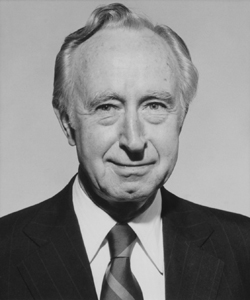
Commissioner Vernon W. Thomson Commissioner Vernon W. Thomson, the Commission's second chairman, was a Republican Member of Congress from Wisconsin from 1961-75. Before that, he was his state's Governor (1957-59), Attorney General (1951-57) and a member of the state legislature (1935-49). He received a B.A. from the University of Wisconsin and was a graduate of its law school. He was originally appointed for five years and for three years when the Commission was reconstituted.
Robert O. Tiernan (R) serves as Commissioner -
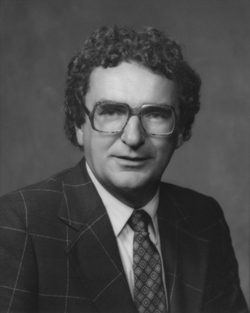
Commissioner Robert O. Tiernan Commissioner Robert O. Tiernan was appointed to the Commission on April 14, 1975. Previously, he served as a Democratic Member of Congress from Rhode Island for eight years. He had also served as a state legislator for seven years.
An attorney, Mr. Tiernan graduated from Providence College and Catholic University Law School and was admitted to practice in all federal courts, the State of Rhode Island and the District of Columbia. He also held various national and state party positions. He was one of the six original Commissioners appointed by President Gerald Ford in 1975.
Thomas E. Harris (D) serves as Commissioner -
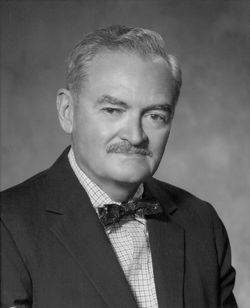
Commissioner Thomas E. Harris Commissioner Thomas E. Harris, was associate general counsel to the AFL-CIO in Washington, DC, from 1955-75. He had held the same position with the CIO from 1948 until it merged with the AFL in 1955. Prior to that he was an attorney in private practice and with various government agencies. A native of Little Rock and a 1932 graduate of the University of Arkansas, Mr. Harris is a 1935 graduate of Columbia University Law School, where he was on the Law Review and was a Kent Scholar. After graduation, he clerked one year for Supreme Court Justice Harlan F. Stone. He was originally appointed for four years and upon reconstitution received a three-year appointment.
Joan D. Aikens (R) serves as Commissioner -
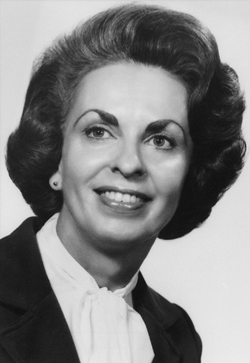
Commissioner Joan D. Aikens Commissioner Joan D. Aikens, a Republican, was first appointed to the Commission in March 1975. Following the reconstitution of the FEC that resulted from the Supreme Court's Buckley v. Valeo decision, President Ford reappointed her to a five-year term. She served as FEC Chair between May 1978 and May 1979. In 1983, President Reagan reappointed Mrs. Aikens, this time for a six-year term. She was reappointed by President Bush in 1989. Mrs. Aikens served as FEC Chair between May 1978 and May 1979, and again in 1986, 1992 and 1998.
Before serving on the Commission, Mrs. Aikens was Vice President of Lew Hodges/Communications, a public relations firm located in Valley Forge, Pennsylvania. From 1972 until 1974, she was president of the Pennsylvania Council of Republican Women and served on the board of directors of the National Federation of Republican Women. She served as Alternate Delegate-at-Large to the 1972 Republican National Convention and, at the time of her appointment to the Commission, she was a member of the Pennsylvania Republican State Committee. She was also active in a variety of other volunteer organizations. A native of Delaware County, Pennsylvania, Mrs. Aikens received her B.A. and honorary Doctor of Law degree from Ursinus College, Collegeville, PA.
In this video clip from 1991, Commissioner Aikens offers a concise description of the FEC's mission.
Orlando B. Potter serves as Staff Director -
Before joining the Commission, Orlando Potter was consultant to the Secretary of the U.S. Senate in the administration of campaign disclosure laws. Prior to that he was legislative assistant to U.S. Senator Claiborne Pell, and in 1968 was a candidate for the U.S. House of Representatives from New York. Mr. Potter previously was a Washington correspondent and editorial writer for the Providence (R.I.) Journal Bulletin. A 1950 graduate of Hamilton College, Mr. Potter also holds a Masters Degree from Yale University. He received a congressional staff fellowship from the American Political Science Association in 1970, and did graduate work in computer science at American University.
John G. Murphy, Jr. serves as General Counsel -

John G. Murphy Jr. John G. Murphy, Jr. came to the Commission from the Georgetown University Law Center, where he is a tenured professor specializing in constitutional law. While on leave from Georgetown, Mr. Murphy advised the Faculty of Law of the Lebanese National University in Beirut for the Ford Foundation. Earlier he served as a consultant to OEO and HEW on developing legal services programs. The General Counsel graduated from Harvard in 1958 and from the Georgetown University Law Center in 1961. He served as editor of the Georgetown Law Journal and, later, as law clerk to the then U.S. District Court of Appeals judge Warren E. Burger.
Public Records Division opens
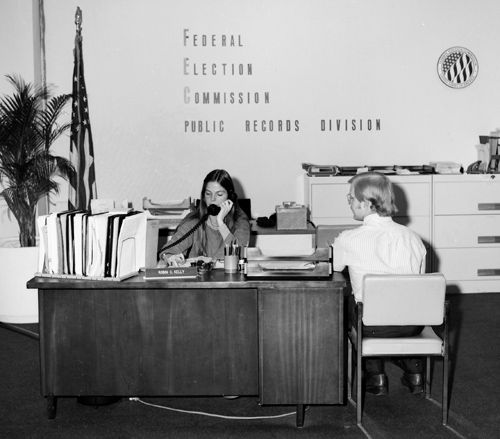
Original FEC Public Records Office, c. 1977 Now known as the Public Records Office, this office maintains the financial records submitted by candidates and committees and makes them available to the public. It was the first Commission office to be fully staffed and operative.
Commission issues first Notice of Proposed Rulemaking
The newly created Federal Election Commission issued its very first Notice of Proposed Rulemaking - a set of proposed regulations upon which the public may comment - to implement the 1974 amendments to the Federal Election Campaign Act of 1971.
FEC disclosure regulations sent to Congress -
The proposed regulations cover the organizational and disclosure provisions of the Federal Election Campaign Act of 1971, as amended in 1974, including: definitions; candidate status; political committee organization and registration; campaign finance recordkeeping and reporting; political party convention finance reports; and filing requirements with state officers.
New Hampshire special election is first to require disclosure reports -
The FEC issued an “Interim Guideline” which stated that the provisions of the 1974 Campaign Finance Act would apply to the special Senate election. The “Interim Guideline” also set forth procedures for candidates and political committees to follow to comply with the financial disclosure requirements and the contribution and expenditure limits of the new law.
FEC stores public documents on microfilm

FEC staff inspect microfilm, c. 1976 The Commission chose to use microfilm as its primary system for storing and retrieving records.
National parties certified
Both major parties were certified as eligible to receive public funds for their presidential nominating conventions.
First candidates certified for matching funds
Terry Sanford, Gerald Ford and Lloyd Bentsen became the first candidates certified to the Secretary of the Treasury for primary matching funds.
-
First mandatory audits of presidential campaigns
1976 marked the first year in which the FEC conducted mandatory audits of publicly funded presidential campaigns.
FEC begins its Regional Seminar Series
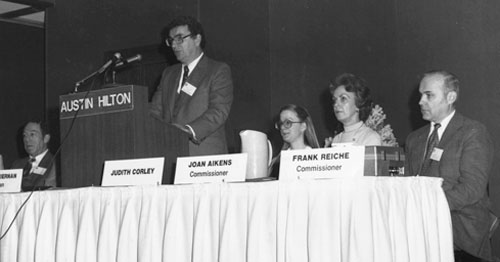
FEC Regional Conference in Austin TX, 1980 (L to R) Commissioner John Warren McGarry,
Chairman Robert Tiernan, Judith Corley, Commissioner Joan Aikens, Commissioner Frank ReicheThe Commission announced it would hold a series of “Regional Seminars” around the country to explain the new Federal Campaign Finance Laws to candidates and political committees. The agency continues to hold a variety of educational outreach programs today.
The Commission opens “storefront” Public Records Office

Original FEC Public Records Office, November 1976 A “storefront” Public Records office was opened on the ground floor of the FEC building in Washington, DC to facilitate public inspection and copying of disclosure reports.
Buckley v. Valeo
The Supreme Court upheld contribution limits as safeguards to the integrity of government by preventing the reality and appearance of corruption of federal officials. The Court also upheld the Act's disclosure regime. However, it overturned most limits on expenditures as limits on First Amendment freedoms. The Court also overturned the Act's provisions on the appointment of Commissioners, holding that the Constitution permitted only the President, with the advice and consent of the Senate, to appoint Commissioners. The Court suspended many of the Commission's functions until Commissioners were reappointed by the President pursuant to the Federal Election Campaign Act (FECA) Amendments of 1976.
Commission implements a computer-based information system Spring 1976

The FEC's first computer network, c. 1976 A computer system was designed and implemented for storing and compiling data from campaign disclosure reports. Six indexes and compilations of campaign finance data were made available prior to the 1976 general election.
FEC's executive powers temporarily suspended -
As a result of the Supreme Court's decision in Buckley v. Valeo, the Commission's executive powers were suspended from March 22, 1976, until President Ford reappointed the Commissioners on May 21, 1976.
FEC publishes first annual report
The Commission issued its first Annual Report to Congress and the President, as required by FECA.
Federal Election Campaign Act Amendments of 1976
The 1976 Amendments (Pub. L. No. 94-283) changed how FEC Commissioners were appointed (to the present-day system where appointment now requires nomination by the President and confirmation by the Senate), repealed campaign expenditure limits (declared unconstitutional by Buckley v. Valeo) and established rules for conducting solicitations of voluntary contributions to corporate and union SSFs.
Justice Brennan delivers oath to FEC Commissioners after reconstitution
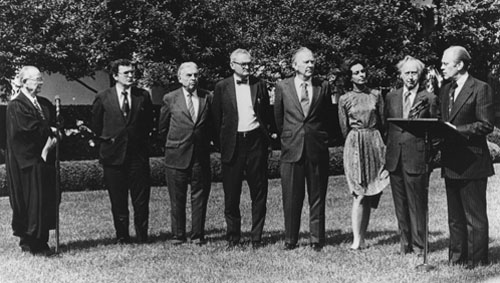
(L to R) Associate Justice William J. Brennan Jr., Robert O. Tiernan, Neil O. Staebler, Thomas E. Harris, William L. Springer, Joan D. Aikens, President Gerald R. Ford President Gerald R. Ford delivered the following remarks at the White House ceremony:
"I think this is a very good day for the country and for the political process that we're going through at the present time. At long, long last, after many regrettable delays, we are finally putting the Federal Election Commission back into business.
The significance of today, however, is that once again we have a watchdog to ensure that the election process proceeds as fairly and as honestly as possible in full accord with the law.
By their actions, the members of this Commission whom we are swearing in today can do a great deal to build and to restore public trust in the political process. This is one of the greatest contributions that anyone can make in public life in America.
So, all of us wish you the very best and wish you well as you begin your work once again."
Citation: Gerald R. Ford: “Remarks at the Swearing In of the Six Members of the Federal Election Commission.,” May 21, 1976. Online by Gerhard Peters and John T. Woolley, The American Presidency Project. https://www.presidency.ucsb.edu/documents/remarks-the-swearing-the-six-members-the-federal-election-commission.William L. Springer (R) serves as Commissioner -
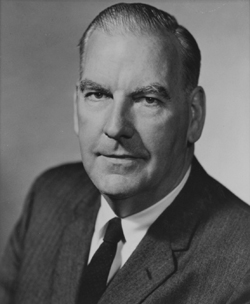
Commissioner William L. Springer Commissioner William L. Springer served as State's Attorney of Champaign County, Illinois, 1940 to 1942. After military service in the Navy, he returned to Champaign, Illinois, and served as County Judge from 1946 to 1950. In 1950 he was elected to the 82nd Congress and was reelected to each succeeding Congress from the 22nd Congressional District of Illinois until his retirement at the close of the 92nd Congress. President Nixon appointed him to be a Commissioner of the Federal Power Commission in 1973. He resigned in December 1975 and was appointed to the FEC by President Ford in 1976. Mr. Springer is a graduate of DePauw University and the University of Illinois Law School. He received LL.D. degrees from Millikin University in 1953, Lincoln College in 1966, and DePauw University in 1972.
First candidates certified for general election grant
The Democratic Party nominees for President and Vice President, Jimmy Carter and Walter Mondale, were certified eligible for Presidential Election Campaign Fund payments. The Republican nominees, Gerald Ford and Robert Dole, were certified on August 24. Each campaign received $21.82 million in public funds for the general election campaign.
FEC publishes first Record newsletter and Campaign Guide series
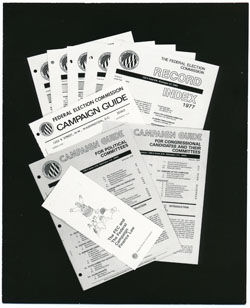
FEC Record and Campaign Guide Series The Commission published its first Record newsletter and a six-part Campaign Guide series to help candidates and committees comply with the Federal Election Campaign Act. Over time, the Record and Campaign Guide series evolved into the comprehensive set of print and online publications that are available today.
The Commission issues first Disclosure Series report
The Commission issued the first report in the FEC Disclosure Series: Presidential Pre-Nomination Receipts and Expenditures, 1976 Campaign. This series was a precursor to the Reports on Financial Activity Series.
Commission releases first public funding audit report
The Commission released its first audit report, covering the Sanford for President Committee. The report is the first statutory audit to be completed on a presidential committee receiving matching funds.
-
Data Systems Development Division established
The Commission established its Data Systems Development Division to manage the agency's information technology.
William C. Oldaker serves as General Counsel -
William C. Oldaker began serving as General Counsel on January 1, 1977, after being Assistant General Counsel for Compliance and Litigation since 1975. Holding B.A. and J.D. degrees from the University of Iowa, he also attended the Graduate School of Business at the University of Chicago. Prior to coming to the Commission, Mr. Oldaker served with the Federal Communications Commission and the Equal Employment Opportunity Commission.
Following its reconstitution, the Commission transmits and then re-transmits regulations implementing FECA to Congress
After its reconstitution on May 21, 1976, the Commission re-published its draft regulations for public comment on May 26. It held hearings in June 1976 on those regulations and submitted final rules to Congress on August 3, 1976. Congress adjourned before the rules had been pending for 30 legislative days, however, meaning that the rules were not promulgated. The Commission voted to make two minor changes and resubmitted the rules to Congress on January 11, 1977.
Commission establishes Office of Planning and Management
The Commission established its Office of Planning and Management to manage the agency's budget.
First set of comprehensive regulations implementing FECA take effect

1977 Code of Federal Regulations, cover The regulations that the Commission had been working on since 1975 finally pended before Congress for 30 legislative days on March 29, 1977; thereby enabling the Commission to promulgate them effective as of April 13, 1977.
-
Commission establishes Reports Analysis Division
The Reports Analysis Division assigns teams of analysts to review reports submitted by filers for accuracy and completeness. If a report is inaccurate or incomplete, the Commission may send the filer a Request for Additional Information (RFAI). An adequate response to the RFAI is processed as any other report. Failing to respond or responding inadequately may be handled as an enforcement case.
Reports of Financial Activity series debuts

FEC staff printing financial activity report, 1982 Reports on Financial Activity was a statistical series of reports that provided a comprehensive study of campaign finance activity by candidates, party committees and nonparty committees in a timely manner.
John Warren McGarry (D) serves as Commissioner -

Commissioner John Warren McGarry Commissioner John Warren McGarry was appointed to the FEC under the “recess appointment” clause of the U.S. Constitution on October 25, 1978. He was reappointed in 1983 and 1989. He served as FEC Chairman in 1981, 1985, 1991 and 1997. Before his Commission appointment, Commissioner McGarry served as special counsel on elections to the House Administration Committee. He previously combined private law practice with service as chief counsel to the House Special Committee to Investigate Campaign Expenditures, a special committee established by Congress every election year through 1972. Before his work with Congress, Commissioner McGarry was the Massachusetts assistant attorney general. After graduating cum laude from Holy Cross College, Commissioner McGarry did graduate work at Boston University and earned a J.D. degree from Georgetown University Law School.
-
Max L. Friedersdorf (R) serves as Commissioner -
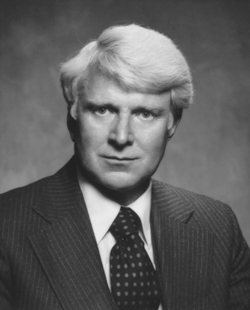
Commissioner Max L. Friedersdorf Commissioner Max L. Friedersdorf, served as Staff Director of the Senate Republican Policy Committee from January 1977 until his appointment to the Commission in February 1979. A native of Indiana, Mr. Friedersdorf received his B.A. from Franklin College in 1952 and earned an M.A. from American University in 1970. He pursued a journalism career in Indiana before serving as administrative assistant and press secretary for former Congressman Richard L. Roudebush (R-Ind.) from 1961 to 1970. In 1970, he was Director of Congressional Relations for the Office of Economic Opportunity. From 1971 to 1977, Mr. Friedersdorf served in several White House posts. He was Deputy Assistant for Congressional Affairs to President Nixon from 1971 to 1974. He continued as Deputy Assistant to President Ford until 1975, when he became the President's Assistant for Legislative Affairs.
Personal financial disclosure statements of all presidential and vice presidential candidates are made available
Presidential and vice presidential candidates must file Ethics in Government Act reports disclosing personal financial information. These reports are filed with the Commission within 30 days of becoming a candidate, under the election law, and on or before May 15 of each successive year in which the individual continues to be a candidate.
Commission approves new data entry procedures for 1980 presidential elections

FEC staff scanning compliance forms, 1982 Data coding and entry of information contained in presidential reports was expanded to include all summary information on campaign receipts and expenditures (including receipt of public funds), information on exempt fundraising expenses, legal and accounting disbursements, and all information on expenditures of public funds in primary campaigns on a State-by-State basis. This new database could provide such up-to-date information on matching fund requests as total contributions submitted for matching funds (by each candidate and a summary figure for all candidates) and total certifications made by the Commission.
Commission certifies initial payment for the Republican National Committee's 1980 national convention
On June 28, 1979, after adopting procedures for the certification of public funds for national party committee nominating conventions, the Commission certifies to the U.S. Treasury an initial payment of $750,000 for the Republican National Committee's 1980 national nominating convention.
Frank P. Reiche (R) serves as Commissioner -

Commissioner Frank P. Reiche On July 31, 1979, Commissioner Frank P. Reiche of Princeton, New Jersey, was sworn into office as an FEC Commissioner by Supreme Court Justice William R. Rehnquist. The ceremony took place at the FEC. Mr. Reiche replaced Commissioner Vernon W. Thomson whose term had expired.
Mr. Reiche was born in Hartford, Connecticut. He received his A.B. from Williams College in 1951 and an M.A. in Foreign Affairs from George Washington University in 1959. An attorney specializing in taxation, Mr. Reiche graduated from Columbia Law School in 1959, and received a Master of Laws degree in Taxation from New York University in 1966. Mr. Reiche was with the Princeton firm of Smith, Stratton, Wise and Heher from 1962 until his appointment to the Commission.
Mr. Reiche was a member of New Jersey Governor William T. Cahill's Tax Policy Committee from 1970 to 1972. Governor Cahill appointed Mr. Reiche Chairman of the first New Jersey Election Law Enforcement Commission in 1973; he was reappointed as Chairman by Governor Brendan Byrne in 1975. The Commission is responsible for the administration and enforcement of the New Jersey campaign finance disclosure act. Prior to that, Mr. Reiche served in a variety of Republican party positions, including eight years as a Republican county committeeman.
Commission certifies initial payment for the Democratic National Committee's 1980 national convention
On August 16, 1979, the Commission certifies to the U.S. Treasury an initial payment of $300,000 for the Democratic National Committee's 1980 national nominating convention.
Information submitted by presidential candidates seeking eligibility for primary matching funds is made available to the public
In addition to the reports filed by presidential candidates on their campaign finance activity, the Public Records Office released lists of contributions (alphabetized by contributor) for which presidential candidates had requested matching payments.
Charles N. Steele serves as General Counsel -
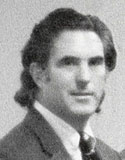
Charles N. Steele, 1982 Mr. Steele became General Counsel in December 1979, after serving as Acting General Counsel during November of that year and as Associate General Counsel for Enforcement and Litigation between April 1977 and October 1979. He received a B.A. from Harvard College in 1960 and an LL.B. from Harvard Law School in 1965. Before joining the Commission in 1976, Mr. Steele was a staff attorney with the appellate court branch of the National Labor Relations Board.
Commission reduces fees
The Commission adopted a policy that reduced fees for information made available to the public in the FEC's Public Records Office. The policy also addressed the availability of standard computer indexes. The Data Systems Development Division would also make available at cost computer tapes on statistical information contained in the Reports on Financial Activity series.
Commission sends to Congress the first comprehensive revision of presidential public funding regulations
Following its experiences with administering the public funding of the 1976 presidential election, the Commission went to work to revise its public funding regulations for the 1980 elections. The revisions included proposed regulations concerning matching funds for presidential primary candidates. The Commission sent three sets of public funding regulations to Congress in 1979.
-
Federal Election Campaign Act Amendments of 1979
The 1979 amendments (Pub. L. No. 96-187) included several modifications. Changes included simplified reporting requirements of federal committees, expanded grassroots opportunities for state and local party committees (by creating what are today known as “exempt party activities”) and prohibited personal use of candidate campaign committee funds.
FEC establishes new procedures for special election reports
The 1979 Amendments to the Federal Election Campaign Act required the Commission to establish filing dates for reports within five days of the setting of the date for a special election. The Commission was also now required to publish the dates and notify the principal campaign committees of all candidates involved in the special election of those reporting dates.
Commission certifies remainder of entitlements to finance 1980 national party conventions and
On February 13, 1980, the Commission certifies the remainder of the Democratic National Committee's full entitlement of $4,416,000 to finance the 1980 Democratic national convention. On February 24, 1980, the Commission certifies the remainder of the Republican National Committee's full entitlement of $4,416,000 to finance the 1980 Republican national convention.
Commission redesigns reporting forms to implement the 1979 amendments
The Commission redesigned the reporting forms to implement the 1979 FECA Amendments and to make the forms easier for committees to use. For the first time, the final forms included line-by-line instructions.
Congress disapproves regulations regarding candidate debates; FEC resubmits along with additional regulations implementing the 1979 FECA amendments
FEC regulations are transmitted to Congress where they must pend for 30 legislative days before going into effect (and at the time these regulations were pending, Congress also could have “disapproved” them; the Supreme Court later ruled this practice to be unconstitutional). In the case of 1979 regulations that set out rules governing the conduct of candidate debates, Congress disapproved the Commission's initial regulations; however, a second revised submission went into effect on April 1, 1980. The Commission also transmitted regulations that implemented the 1979 amendments to the FECA. Both sets of regulations took effect April 1, 1980.
U.S. Supreme Court upholds constitutionality of the Presidential Election Campaign Fund Act
On April 14, 1980, the U.S. Supreme Court unanimously affirms two lower court decisions upholding the constitutionality of the Presidential Election Campaign Fund Act challenged by the Republican National Committee in RNC v. FEC, 445 U.S. 955 (1980).
Commission's revised FOIA regulations and new regulations governing access to public records take effect
The Commission's revised regulations on the Freedom of Information Act (FOIA) became effective, as did new regulations governing public access to Commission documents. The regulations set out uniform procedures and fees for providing documents to the public both under FOIA and pursuant to the Commission's public disclosure duties.
Commission introduces new computer indexes on independent expenditures
In response to the growing interest in independent expenditure activity, the Commission created three new indexing programs. The first index listed independent expenditures by the committee or person who made them, indicating the candidates they supported or opposed and the total amounts they spent, per candidate. The second index gave the particulars of each independent expenditure as well as the summary information provided by the first index. The third index, a revision of one used in 1979, listed independent expenditures by candidate, providing the details of each expenditure made for or against a candidate.
Commission certifies public funds to 1980 major party general election presidential campaigns and
The Commission certifies $29.44 million in public funds each to the general election campaigns of Republican presidential nominee Ronald Reagan and his running mate, George Bush (on July 24, 1980), and of Democratic presidential nominee Jimmy Carter and his running mate, Walter Mondale (on August 21, 1980).
Commission adopts new procedures for approving computerized forms
The Commission authorized the Report Analysis Division to approve computerized formats used by committees to itemize their receipts and disbursements.
B. Allen Clutter, III serves as Staff Director -
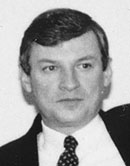
B. Allen Clutter III, 1982 Before joining the Commission, B. Allen Clutter, III was the executive director of the Minnesota Ethical Practices Board and also served as faculty member of the Hamline University Law School. Prior to this, Mr. Clutter was an assistant professor at the U.S. Air Force Academy and served with the Air Force administrative units in Thailand and California. He also worked with the World Press Institute of Macalester College in St. Paul, Minnesota. A native of Oskaloosa, Iowa, he received a graduate degree in geography from Eastern Michigan University and attended business administration courses at the University of Colorado. Mr. Clutter was listed among the Outstanding Young Men in America in 1978.
Commission certifies public funds to 1980 new party candidate
On November 13, 1980, the Commission certifies $4,164,906 in public funds to the general election campaign of new party presidential candidate John Anderson and his running mate, Patrick Lucey.
-
Vernon W. Thomson (R) serves interim appointment as Commissioner -
Commissioner Vernon W. Thomson Commissioner Vernon W. Thomson, the Commission's second chairman, was a Republican Member of Congress from Wisconsin from 1961-75. Before that, he was his State's Governor (1957-59), Attorney General (1951-57) and a member of the State legislature (1935-49). He earned a B.A. from the University of Wisconsin and graduated from its law school. He was originally appointed for five years and for three years when the Commission was reconstituted.
Commission certifies additional funds to new party candidate for 1980 campaign
On January 8, 1981, the Commission certifies an additional $77,398 in public funds for the general election campaign of new party presidential nominee John Anderson and his running mate, Patrick Lucey.
FEC adds consolidated index of documents
The Commission announced the availability of a card index that consolidates information on Commission advisory opinions, completed compliance cases and completed audits.
Computer tapes summarize 1977-78 campaign finance information
The Commission made available computer tapes containing final information on 1977-78 campaign finances of party and nonparty (noncandidate) committees.
Microfilmed audit reports made available
The Commission made available for public view and purchase microfilm cartridges of audit reports issued between 1975 and 1980.
California Medical Association v. FEC
The Supreme Court held that the annual limit on contributions to multicandidate political committees (or PACs) did not violate the First Amendment or the constitutional guarantee of equal protection, even though it placed some restrictions on unincorporated associations that were not placed on corporations and labor unions.
FEC v. Democratic Senatorial Campaign Committee
In reviewing the Commission's dismissal of an administrative complaint, the Supreme Court found that deference was owed to the Commission in that context and held that the FEC's interpretation of the Act to permit a state party committee to enter into an agency agreement with a national senatorial committee was sufficiently reasonable to survive judicial review.
Press Office relocates to be near Public Records Office
The Press Office relocated to the first floor, across from the Public Records Office. The move was designed to help reporters coordinate their research in the two offices and provide easier access to FEC press spokespersons.
Lee Ann Elliott (R) serves as Commissioner -

Commissioner Lee Ann Elliott Commissioner Lee Ann Elliott was first appointed in 1981 and reappointed in 1987 and 1994. She served as Chairman in 1984, 1990 and 1996. Before her first appointment, Commissioner Elliott was vice president of a political consulting firm, Bishop, Bryant & Associates, Inc. From 1961 to 1979, she was an executive of the American Medical Political Action Committee. Commissioner Elliott was on the board of directors of the American Association of Political Consultants and on the board of the Chicago Area Public Affairs Group, of which she is a past president. She was also a member of the Public Affairs Committee of the U.S. Chamber of Commerce. In 1979, she received the Award for Excellence in Serving Corporate Public Affairs from the National Association of Manufacturers.
A native of St. Louis, Commissioner Elliott graduated from the University of Illinois. She is a Certified Association Executive, an author, lecturer, educator and patent holder.
Danny L. McDonald (D) serves as Commissioner -
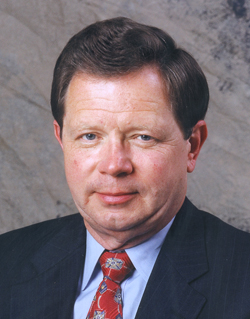
Commissioner Danny L. McDonald Commissioner Danny L. McDonald, a Democrat, originally was nominated to the Commission by President Ronald Reagan in December 1981, and confirmed by the U.S. Senate in July 1982. He served as FEC Chairman in 1983, 1989, 1995, and 2001.
Prior to his initial appointment in 1981, the Sand Springs, Oklahoma, native served as General Administrator of the Oklahoma Corporation Commission. Additionally, he served as Secretary of the Tulsa County Election Board and as Chief Clerk of that Board. He was also a member of the Advisory Panel to the FEC's National Clearinghouse on Election Administration. Commissioner McDonald received a B. A. Degree from Oklahoma State University and attended the John F. Kennedy School of Government at Harvard University. He has served as a member of the JFK School Advisory Board for State and Local Government.
-
Microfilmed agenda items made available

FEC staff at microfilm reader, 1979 The Commission microfilmed all agenda items discussed in open Commission meetings from 1975 through 1980 and developed a computerized index to help locate the documents. This process facilitated both public and staff access to Commission agenda items.
Bread Political Action Committee v. FEC
The Supreme Court held that trade associations and political committees, which were not among the three categories of parties listed in 52 U.S.C. § 30110 (then 2 U.S.C. § 437h), could not invoke that provision's special procedure for judicial review of constitutional claims.
FEC v. National Right to Work Committee
The Supreme Court held that the persons a corporation solicited to contribute to its separate segregated fund were insufficiently attached to the corporation to qualify as members under 52 U.S.C. § 30118(b)(4)(C) (then 2 U.S.C. § 441b(b)(4)(C)), and that any burden on First Amendment associational rights this interpretation of the Act caused was outweighed by the interests Congress sought to protect in limiting such activity.
-
FEC introduces Matter Under Review (MUR) index
The Commission introduced a computerized FEC MUR Index, which presented information on publicly released enforcement cases.
Commission certifies public funds for major party 1984 presidential nominating conventions
The Commission certifies $5,871,000 in public funds to both the Republican and Democratic parties for their 1984 national presidential conventions.
John C. Surina serves as Staff Director -
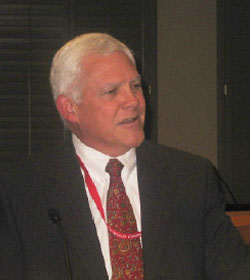
John C. Surina, Staff Director Before joining the Commission in July 1983, John C. Surina was assistant managing director of the Interstate Commerce Commission (ICC), where he was detailed to the “Reform 88” program at the Office of Management and Budget. In that role, he worked on projects to reform administrative management within the federal government. From 1973 to 1980, Mr. Surina served the ICC in other capacities. Between 1972 and 1973 he was an expert consultant to the Office of Control and Operations, EOP-Cost of Living Council-Pay Board. He was previously on the technical staff of the Computer Sciences Corporation. Mr. Surina joined the U.S. Army in 1966, completing his service in 1970 as executive officer of the Special Security Office. In that position, he supported senior U.S. delegates to NATO's civil headquarters in Brussels, Belgium. A native of Alexandria, Virginia, Mr. Surina holds a B.S. in Foreign Service from Georgetown University. He also attended East Carolina University in Greenville, North Carolina, and American University in Washington, DC.
Presidential computer index debuts
The Commission introduced a new computer index that provided a concise summary of the financial activity of major presidential campaigns. The 1984 Presidential Campaign Summary Report was designed to extract information from reports filed by presidential campaigns and to adjust numbers to reflect actual amounts raised and spent.
-
FEC begins Monday afternoon clinics
The Commission began hosting Monday afternoon clinics to assist committees.
Program providing state access to data begins -
Six State election offices joined the Commission in a 1984 pilot project to broaden the accessibility of computerized campaign finance information. The primary objective was to give those located outside Washington, DC, immediate access to several FEC computer indexes. The State offices had a computer terminal linked to the FEC computer through a national telecommunications system.
Commission certifies additional public funds for major party 1984 presidential nominating conventions
The Commission certifies an additional $2.020 million in public funds to both the Republican and Democratic parties for their 1984 national presidential conventions, bringing each party's grant to $8.080 million.
Commission certifies public funds for major party 1984 general election campaigns and
The Commission certifies $40.4 million in public funds each for the general election campaigns of Democratic presidential nominee Walter Mondale and his running mate, Geraldine Ferraro (on July 26, 1984) and of Republican presidential nominee Ronald Reagan and his running mate, George Bush (on August 27, 1984).
Commission revises its regulations on access to information
The Commission revised regulations that affected the activities of the Press Office, which handled requests made under the Freedom of Information Act (FOIA), and the Public Records Office. The new rules updated fees to reflect actual costs of providing documents. The regulations also changed the billing procedures for the sale of FEC microfilm and computer tapes. The amended rules provided that individuals who purchase these materials pay the firm that reproduces them, rather than the FEC. Finally, the revised regulations made clear that the FEC does not charge for staff time devoted to duplicating information to fill FOIA requests.
New regulations implement Rehabilitation Act
The Commission promulgated regulations that provided for programs and auxiliary aids to ensure handicapped persons' access to Commission information and facilities.
-
FEC v. National Conservative Political Action Committee
The Supreme Court held that 26 U.S.C. § 9012(f), a provision of the Presidential Election Campaign Fund Act limiting independent expenditures by political committees to further the election of publicly financed candidates, violated the First Amendment.
FEC reorganizes Information Services Division
The Commission divided the Information Services Division into three parts: Information, Press and Clearinghouse.
FEC publishes Ten Year Report

The First Ten Years, 1975-1985 The Commission published The First Ten Years, a special report to mark the agency's 10th anniversary. The report reviewed the historical context in which the Commission was formed and described the agency's role in administering the FECA during its first decade.
Testing-the-waters regulations provide guidance to potential candidates
After a series of early 1980s Advisory Opinions about activities of prospective presidential candidates, the Commission issued regulations that exempted individuals “testing-the-waters” from having to register as candidates, so long as their activities were limited in scope as defined by the regulations. These rules remain in effect today.
Thomas J. Josefiak (R) serves as Commissioner -
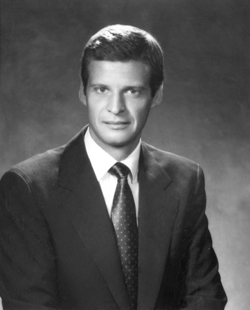
Commissioner Thomas J. Josefiak Commissioner Thomas J. Josefiak was appointed to the Commission in 1985 and was the 1988 FEC Chairman. He previously served at the Commission as Special Deputy to the Secretary of the Senate. Before assuming that post in 1981, he was legal counsel to the National Republican Congressional Committee. His past experience also includes positions held at the U.S. House of Representatives. He was minority special counsel for federal election law on the Committee on House Administration, U.S. House of Representatives and served as legislative assistant to the late Congressman Silvio O. Conte.
A native of Massachusetts, Mr. Josefiak graduated from Fairfield University, Connecticut, and earned a J.D. degree from Georgetown University Law Center.
Direct computer access (Direct Access Program) debuts
The Commission inaugurated a subscription service that provided individuals with direct computer access to the FEC campaign finance disclosure base. In addition, users could request raw data, which they could store and then arrange according to their own research needs.
-
FEC completes move to new headquarters

FEC Headquarters 999 E Street, NW, Washington, DC The Commission completed its move from K Street to a new headquarters building at 999 E Street, NW, Washington, DC on February 18, 1986.
Scott E. Thomas (D) serves as Commissioner -

Commissioner Scott E. Thomas Commissioner Thomas began his service at the FEC as a legal intern during the summer of 1975. The Commission had just opened its doors in the wake of the Watergate scandal and related congressional hearings. Upon graduating from law school in 1977, Mr. Thomas worked on the FEC's legal staff, eventually serving as an Assistant General Counsel in the Enforcement Division. In 1983, he became Executive Assistant to then Commissioner Tom Harris, a Democrat and one of the original FEC Commissioners.
In 1986, with Commissioner Harris retiring, President Reagan appointed Mr. Thomas to the remainder of a six-year term. He was reappointed in 1991 by President Bush, and reappointed again by President Clinton in 1997.
Commissioner Thomas served as FEC Chairman in 1987, 1993, 1999 and 2005. He focused over the years on improving the enforcement process through the Enforcement Priority System and adequate staffing, restricting the use of “soft money” through the Commission's allocation regulations, and streamlining Commission audit, reports analysis, and disclosure procedures.
Commissioner Thomas hails from Wyoming where he graduated from Lander Valley High School in 1970. He received a degree in political science from Stanford University in 1974, and graduated from Georgetown University Law Center in 1977.
FEC Commissioners group photo

(L to R) Sitting - Vice Chairman John Warren McGarry and Chairwoman Joan D. Aikens. Standing - Senate Ex Officio Scott Morgan, Commissioners Danny L. McDonald, Lee Ann Elliott, Scott E. Thomas, Thomas J. Josefiak and House Ex-Officio Douglas Patton Massachusetts Citizens for Life (MCFL) v. FEC
The Supreme Court ruled that prohibitions on corporate expenditures were unconstitutional as applied to independent expenditures made by a narrowly defined type of nonprofit corporation.
Budget cuts reduce accessibility of computerized campaign finance data -
As a result of the Gramm-Rudman-Hollings Deficit Reduction Act and a cut in personnel funds, the Commission sustained a loss of $858,000 from its fiscal year 1986 funding. The largest cuts ($250,000) were borne by the computerized disclosure program, resulting in a reduction in the amount of campaign finance information accessible through the computer. In addition, the Commission's program to provide states with computer access to the FEC's campaign finance database was curtailed. Both were later restored using fiscal year 1987 funds.
-
FEC publishes citizens guide

Citizens Guide The Commission published Supporting Federal Candidates - A Guide for Citizens to provide the public a brief overview of the FECA's limits, prohibitions and disclosure requirements. The current edition of the Citizens Guide is available on the FEC's website and on its YouTube channel
Commission certifies public funds for major party 1988 presidential nominating conventions
The Commission asked the Secretary of the Treasury to pay $8,892,000 in public funds to both the Republican and Democratic parties to finance their 1988 national presidential conventions.
Lawrence M. Noble serves as General Counsel -

Lawrence M. Noble Lawrence M. Noble became General Counsel in 1987, after serving as Acting General Counsel. He joined the Commission in 1977, becoming the Deputy General Counsel in 1983. He previously served as Assistant General Counsel for Litigation and as a litigation attorney. Before his FEC service, he was an attorney with the Aviation Consumers Action Project. A native of New York, Mr. Noble holds a degree in political science from Syracuse University and a J.D. degree from the National Law Center at George Washington University. He is a member of the bars for the U.S. Supreme Court, the U.S. Court of Appeals for the DC Circuit and the District of Columbia. He is also a member of the American and District of Columbia Bar Associations.
-
Commission certifies additional public funds for major party 1988 presidential nominating conventions
The Commission certifies an additional $328,000 in public funds to both the Republican and Democratic parties to finance their 1988 national presidential conventions.
The Commission offers first warning on potential shortfall
The Commission offers its first warning on a potential shortfall in the Presidential Election Campaign Fund.
Commission adopts new procedures to speed up enforcement
The Commission approved a recommendation by the General Counsel's Office to expedite FEC enforcement matters involving violations of the election law's reporting requirements.
FEC produces videos for House and Senate candidates and state parties

The cover of Why Me?, the FEC's
instructional video for candidates.The Commission produced two videotapes, one for House and Senate campaigns entitled Why Me? and another for state party committees entitled Help. The tapes presented an overview of major statutory provisions and were mailed to all registered House and Senate campaigns and state party committees.
The Commission certifies grants to 1988 presidential general election campaigns and
The Commission certifies $46.1 million each in public funds to the general election campaigns of Democratic presidential nominee Michael Dukakis and his running mate, Lloyd Bentsen (on July 26, 1988) and of Republican presidential nominee Vice President George Bush and his running mate, Dan Quayle (on August 22, 1988).
-
Office automation project provides Commission staff with new equipment
The Commission replaced its 1970s-vintage word processing equipment with an up-to-date office automation system. Staff used their new desktop terminals to locate data in minutes.
FEC sends questionnaires to state parties
The Commission sent questionnaires regarding allocation methods to state party chairs.
Commission warns Congress of possible funding shortfall and
Chairman Danny L. McDonald alerts Members of Congress of a projected 1996 deficit in Presidential Election Campaign Fund and consequences to the public funding system in letters sent on April 3, 1989 and November 1, 1989.
FEC delegation visits USSR
At the invitation of the Central Electoral Commission of the USSR, a 12-person delegation of Commissioners and FEC staff visited the Soviet Union to exchange information and ideas on the electoral process with government officials and academics.
USSR delegation visits FEC

L to R - CEC Chairman Vladimir Orlov, FEC Chairman Danny Lee McDonald A delegation from the USSR's Central Electoral Commission visited the US to exchange information and ideas on the electoral process with government officials and academics.
-
Lynne A. McFarland serves as Inspector General -

Lynne A. McFarland Ms. Lynne A. McFarland was appointed by the Federal Election Commission to serve as the agency's first permanent Inspector General on February 9, 1990.
Ms. McFarland was responsible for establishing the Office of Inspector General (OIG) in the Federal Election Commission from the ground up. This required staffing the office with the appropriate skill sets, ensuring the necessary policies and procedures were created, and creating an initial audit/work universe. As with all IGs, she had dual reporting responsibilities to Congress and the head of the agency, in this instance six presidentially appointed Commissioners.
Ms. McFarland was actively involved in the Inspector General community, serving on the committee that provided the groundwork for the Council of Inspectors General on Integrity and Efficiency (CIGIE) operations once the Inspector General Reform Act was passed by Congress and signed by the President. She is a past Vice Chair of the Professional Development Committee. Ms. McFarland also served as CIGIE Vice Chair from January 1, 2013 to December 31, 2014.
Ms. McFarland was Chair of the Inspector General Recommendation Panel which receives resumes from those interested in presidentially or agency appointed inspector general positions. The panel reviews the resumes, along with a questionnaire all applicants are asked to complete, and forwards those applicants to the White House Office of Personnel that would appear to be qualified candidates for their consideration. The panel also provides assistance to those agencies that select their own IGs through their competitive process.
Commission warns of possible funding shortfall for 1992 presidential campaigns
The Commission notifies Congress, the President and the Secretary of the Treasury that the Presidential Election Campaign Fund will likely be insufficient to finance the 1992 campaigns.
Commission asks Treasury Department to write rules to address shortfall
The Commission asks the U.S. Department of the Treasury to write rules to address the looming shortfall in the Presidential Election Campaign Fund.
-
Commission promulgates new rules on allocating spending that affects both federal and nonfederal elections
Originating from a rulemaking petition filed in 1984, the Commission promulgated rules on the allocation of expenditures by party committees and PACs that affect both federal and nonfederal elections. The rules sought to address which expenditures must be paid for with “hard” federal dollars, and which expenditures could be partially funded with “soft” money raised under nonfederal law. During the rulemaking, the Commission issued four notices of proposed rules for comment, conducted two hearings, and asked 110 state party heads and chief national party fundraisers for input. Approved in June 1990, the rules went into effect beginning with the 1992 election cycle, and the Commission undertook extensive outreach efforts to train party committees in the new “allocation” system. BCRA ultimately invalidated many of the allocation regulations promulgated in 1991 that affected political party spending, and the Commission removed those provisions in subsequent rulemakings (see entry under 2003).
FEC offers allocation training to party committees
Commission representatives travelled to several cities to conduct training sessions on new allocation regulations. The training program was designed to help state and local party committees comply with new rules that specified methods for allocating disbursements for activities that jointly benefit federal and nonfederal candidates and elections. Under the new rules, committees that maintained federal and nonfederal accounts would be required to file new reporting schedules disclosing information on allocated activity.
FEC projects public funding shortfall
The Commission opened 1991 discussing the possible shortfall in the fund for the 1992 cycle. Commissioners appeared in various media outlets to inform the public about the tax checkoff program.
FEC launches public education program on tax checkoff
The Commission launched a public education program to teach taxpayers about the purpose of the dollar tax checkoff. This came after years of declining participation. The public information program featured television and radio public service announcements as well as newspaper Op-ed pieces, a brochure, a flyer, and media appearances by the Chair. This phase of the program reached 92 million taxpayers.
Commission declines to adopt proposed ban on U.S. subsidiaries of foreign corporations forming PACs
After a series of Advisory Opinions permitted domestic subsidiaries of foreign corporations to establish and administer SSFs (with some restrictions), the Commission considered, but ultimately decided not to adopt, proposed regulations prohibiting such subsidiaries from having SSFs.
Commission certifies public funds to major parties for 1992 nominating conventions and
The Commission certifies the eligibility of the 1992 Democratic National Convention Committee (on June 28, 1991) and the Committee on Arrangements for the 1992 Republican National Convention (on July 3, 1991) to receive $10.6 million each for their presidential nominating conventions.
-
Trevor Potter (R) serves as Commissioner -
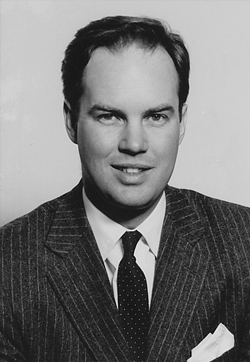
Commissioner Trevor Potter Trevor Potter was confirmed by the Senate as a Commissioner in November of 1991. He served as FEC Chairman in 1994.
Before his appointment, Mr. Potter specialized in campaign and election law as a partner in a Washington, DC law firm. His previous experience in government includes serving as Assistant General Counsel at the Federal Communications Commission from 1984 to 1985 and as a Department of Justice attorney from 1982 to 1984.
Mr. Potter graduated from Harvard College. He earned his J.D. degree at the University of Virginia School of Law, where he served as editor-in-chief of the Virginia Journal of International Law and was a member of the order of the Coif. He served as vice chairman of the American Bar Association Committee on Election Law, Administrative Law Section.
Commission press conference and educational outreach campaign regarding shortfall
In a press conference, the Commission makes an announcement concerning an educational outreach campaign to alert the public to the shortfall in the Presidential Election Campaign Fund. The same day, the Commission introduces checkoff education ads and a special checkoff 800-number.
Chair Aikens appears on C-SPAN to discuss shortfall in 1992 presidential campaign funding
Chair Joan D. Aikens appears on a C-SPAN call-in show to discuss the public funding program and the possible shortfall, as well as the FEC's efforts to get the checkoff raised.
Direct Access Program expands
The Direct Access Program, launched in 1985, expanded its offerings to include computer access to advisory opinions and court cases.
Commission predicts 1996 shortfall in press
In a press conference, the Commission predicts 1996 shortfall in the Presidential Election Campaign Fund unless Congress amends the law. Also on this day, Chair Aikens discusses the tax checkoff on Larry King's nationally-syndicated radio program.
Commission certifies public funds to 1992 general election major party candidates and
The Commission certifies $55.25 million each in public funds to the general election campaigns of Democratic presidential nominee Bill Clinton and his running mate, Albert Gore, Jr. (on July 17, 1992) and of Republican presidential nominee George Bush and his running mate Dan Quayle (on August 21, 1992).
FEC Commissioners group photo
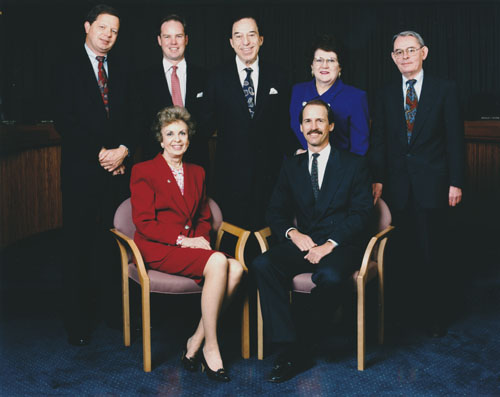
(L to R) Sitting - Chair Joan D. Aikens, Vice Chairman Scott E. Thomas. Standing - Commissioners Danny L. McDonald, Trevor Potter, John W. McGarry, Lee Ann Elliott, Senate Ex-Officio David G. Gartner -
Fax service implemented
The Public Records Office implemented a fax service under which, for example, a subscriber could place a standing order to receive copies of all items on the agenda of a Commission meeting when those documents became public, or copies of all advisory opinions as they were issued.
FEC publishes comprehensive report on public funding and

Public Funding Report A comprehensive report published by the FEC on July 23, 1993 (with advance copies released on April 14, 1993) chronicles the history and experiences of presidential public funding and forecasts a warning for the 1996 shortfall.
Tax checkoff increased from $1 to $3
President Clinton signed the Omnibus Budget Reconciliation Act, which raised the $1 checkoff to a $3 checkoff for the Presidential Election Campaign Fund.
Congress amends FECA in the late 1980s and early 1990s -
In the late 1980s and early 1990s, several amendments to FECA were enacted, including provisions that:
- Banned honoraria for federal officeholders (Pub. L. No. 109-90, 1991);
- Repealed a grandfather clause that had permitted some Members of Congress to convert excess campaign funds to personal use (Pub. L. No. 101-194, 1989);
- Assigned significant new administrative duties to the Commission under the National Voter Registration Act (Pub. L. No. 104-132, 1993; effective 1/1/1995); and
- Increased the tax checkoff for the Presidential Election Campaign Fund from $1 to $3 (Pub. L. No. 103-66, 1993).
Commission announces Enforcement Prioritization System
At a news conference, Chairman Scott E. Thomas announced implementation of a comprehensive enforcement prioritization system designed to produce timely resolution of significant cases.
-
Commission automates toll-free line
The FEC added an automated menu to its toll free information line.
"Flashfax" system
The Commission introduced its automated Flashfax service. The technology permitted callers to dial a phone number, review a menu of documents and, using a touch-tone phone, place an order for documents to be faxed to them in a return call.
FEC v. NRA Political Victory Fund and
In October 1993, the U.S. Court of Appeals for the D.C. Circuit ruled that the composition of the Commission “violates the Constitution's separation of powers” because Congress “placed its agents, the Secretary of the Senate and the Clerk of the House of Representatives, on the independent Commission as non-voting ex officio members.” In response, the Commission voted to reconstitute itself as a six-member body and as a precaution, voted to ratify its regulations in effect at the time.
In December 1994, the Supreme Court ruled that the Solicitor General must represent the Commission before that Court in FECA cases.
-
FEC publishes Twenty Year Report

Twenty Year Report To mark its 20th anniversary, the FEC issued a Twenty Year Report. The Report provided a brief historical context, reviewed the agency's administration and enforcement of the law and examined key issues the Commission was debating at the time. The Report concluded with a chapter that offered FEC statistics to supplement the debate over the role of PACs and parties, and the costs of political campaigns.
Commission certifies funds for major parties' 1996 presidential nominating conventions
On June 30, 1995, the Commission certified the eligibility of the Democratic National Convention Committee and the Committee on Arrangements for the 1996 Republican National Convention to receive $12.024 million each for their 1996 presidential nominating conventions.
Pilot program for electronic filing begins
The FEC invited selected PACs, party committees and candidate committees to participate in a voluntary pilot program for electronic filing. Committees were selected on the basis of their proximity to the FEC and the complexity of their reports.
Commission issues regulations on independent expenditures by non-profit corporations
In 1986, the Supreme Court held in FEC v. Massachusetts Citizens for Life that certain nonprofit corporations could legally make independent expenditures. A resulting petition for rulemaking initiated the FEC's rulemaking in response and garnered over 17,000 comments. The Commission ultimately promulgated new rules amending the definition of “express advocacy” and describing the nonprofit organizations that were exempt from the Act's ban on corporate independent expenditures (this ban was later found unconstitutional as to all corporations in Citizens United).
New legislation: point of entry and electronic filing
President Clinton signed Public Law 104-79, which contained important changes to the ways certain FEC reports were filed. The legislation officially changed the point of entry for House candidates' reports and paved the way for the State filing waiver program and electronic filing. Candidates had previously filed their reports with the Clerk of the House, but on January 1, 1996, they began filing them with the FEC. (The law did not affect the point of entry for reports from Senate candidates.) The amendments also waived the requirement for candidates to file reports in their respective states, if the state permitted electronic access to and duplication of FEC reports. Finally, the law authorized the Commission to develop the technical and regulatory framework to enable political committees to file reports on computer disk or through other electronic means.
-
The FEC has a new address: http://www.fec.gov
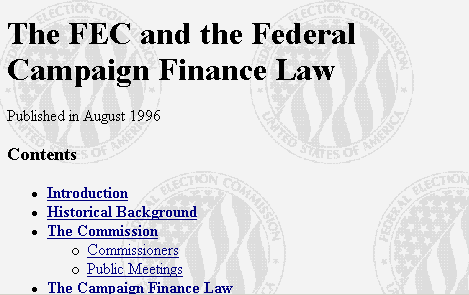
A sample page from the very first FEC.gov website. The FEC launched its first website, offering the public another FEC access point for information on campaign financing and the election process.
House candidates begin filing directly with FEC
As a result of a 1995 legislative change, House candidates began filing campaign finance reports directly with the FEC, rather than with the Clerk of the House. The change in point of entry improved both the timeliness and quality of the Commission's public disclosure process.
FEC initiates pilot program for electronic filing via computer disk
The Commission also took steps during 1996 to implement an electronic filing system that would allow committees to file reports via computer disk or other electronic format on a voluntary basis.
First general election grant certified to third party
For the first time, the FEC certified a partial public funding grant to a third party presidential campaign. The Reform Party's Perot/Choate campaign received a $22.055 million general election grant.
Commission certifies funding for 1996 major party general election candidates and
The Commission certifies $61.82 million each in public funds to the general election campaigns of Democratic presidential nominee President Bill Clinton and his running mate, Vice President Albert Gore, Jr. (on August 30, 1996) and of Republican presidential nominee Bob Dole and his running mate Jack Kemp (on August 15, 1996).
-
Interim electronic filing program begins
The Commission launched an interim Electronic Filing Program that allowed committees to file reports via computer disk. To assist electronic filers, the agency created and distributed free filing software, named FECFile, to more than 200 interested users.
Legislation limiting Commissioners to one term in office enacted ; Effective after
The Treasury and Government Appropriations Act, 1998, Pub. L. No. 105-61, Sec. 512, signed into law on October 10, 1997, contained a clause that limited FEC Commissioners to a single term of six years. The amendment applied to individuals nominated by the President after December 31, 1997.
-
Disclosure reports added to the FEC's website
With the exception of Senate filings, all 1997-1998 cycle reports filed by PACs, political parties, presidential and House campaigns were made available for viewing at the click of a button. The agency updated its website within 48 hours of receipt of paper reports.
Senate candidates and their campaign committees, as well as committees supporting/opposing only Senate candidates, filed their reports directly with the Secretary of the Senate. Because the Commission received these reports on microfilm and did not receive the original copy of these reports, it was impossible to achieve the quality necessary for imaging purposes. As a result, they were not included in this program.
Electronic filing enhanced to allow committees to transmit reports directly to FEC
The second version of the agency's free electronic filing software, FECFile, became available. Electronic filers could now send their computer-prepared reports electronically through a direct transmission to the FEC.
James A. Pehrkon serves as Staff Director -
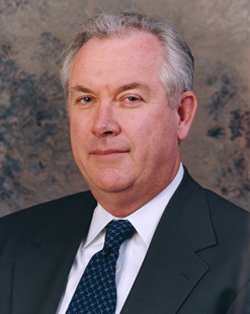
James A. Pehrkon, 2001 James A. Pehrkon became Staff Director on April 14, 1999, after serving as Acting Staff Director for eight months. Prior to that, Mr. Pehrkon served for 18 years as the Commission's Deputy Staff Director with responsibilities for managing the FEC's budget, administration and computer systems. Among the agency's first employees, Mr. Pehrkon is credited with setting up the FEC's Data Systems Development Division. He directed the data division before assuming his duties as Deputy Staff Director. An Austin, Texas, native, Mr. Pehrkon received an undergraduate degree from Harvard University and did graduate work in foreign affairs at Georgetown University
FEC unveils new query system on website
The Commission added a new online query system that provided immediate access to the name and contribution amount of any individual who had contributed $200 or more to a federal political committee during the 1997-1998 election cycle. The FEC's new searchable database also allowed users to access lists of PACs or party committees that have contributed to specific candidates and view lists of candidates to whom selected PACs and parties have contributed.
Darryl R. Wold (R) serves as Commissioner -
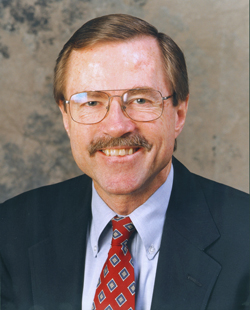
Commissioner Darryl R. Wold Darryl R. Wold was nominated to the Commission by President Clinton on November 5, 1997, and confirmed by the U.S. Senate on July 30, 1998. He served as Chairman in 2000.
Prior to his appointment, Commissioner Wold had been in private law practice in Orange County, California, since 1974. In addition to his own practice, he was counsel to Reed and Davidson, a California law firm, for election law litigation and enforcement defense matters. Mr. Wold's practice included representing candidates, ballot measure committees, political action committees and others with responsibilities under federal, state and local election laws. Mr. Wold's business practice emphasized business litigation and counseling closely-held companies.
Commissioner Wold graduated cum laude from Claremont McKenna College in California and earned an LL.B. from Stanford University. He is a member of the California and U.S. Supreme Court bars. Commissioner Wold departed from the Commission on April 1, 2002.
Karl J. Sandstrom (D) serves as Commissioner -

Commissioner Karl J. Sandstrom Commissioner Karl J. Sandstrom, a Democrat, was nominated to the Commission by President William Clinton on July 13, 1998 and confirmed by the U.S. Senate on July 30, 1998.
Prior to his appointment Commissioner Sandstrom served as Chairman of the Administrative Review Board at the Department of Labor. From 1988 to 1992 he was Staff Director of the House Subcommittee on Elections, during which time he also served as the Staff Director of the Speaker of the House's Task Force on Electoral Reform. From 1979 to 1988, Mr. Sandstrom served as the Deputy Chief Counsel to the House Administration Committee of the House of Representatives. In addition, he has taught public policy as an Adjunct Professor at the American University.
GAO conducts customer satisfaction survey regarding FEC products, services and processes
The GAO contacted randomly selected congressional candidate committees, political party committees and PACs to evaluate the FEC's effectiveness in providing information to the regulated community and facilitating disclosure of campaign finance information.
David M. Mason (R) serves as Commissioner -

Commissioner David M. Mason David M. Mason was nominated to the Commission by President William Clinton on March 4, 1998 and confirmed by the U.S. Senate on July 30, 1998. He was nominated for a second term by President George W. Bush on December 19, 2005. He served Chairman in 2002 and 2008.
Prior to his appointment, Mr. Mason was Senior Fellow in Congressional Studies at the Heritage Foundation. He joined Heritage in 1990 and served at various times as Director of Executive Branch Liaison, Director of the Foundation's U.S. Congress Assessment Project, and Vice President, Government Relations.
Commissioner Mason served as Deputy Assistant Secretary of Defense, where he managed the Pentagon's relations with the U.S. House of Representatives. One of his major accomplishments there was guiding base closing legislation to a successful conclusion.
He has served on Capitol Hill, as a Legislative Assistant to Senator John Warner, Legislative Director to Representative Tom Bliley, and Staff Director to then-House Republican Whip Trent Lott. He was active as a staffer and volunteer in numerous Congressional, Senate, Gubernatorial and Presidential campaigns, and was himself the Republican nominee for the Virginia House of Delegates in the 48th District in 1982.
Commissioner Mason attended Lynchburg College in Virginia and graduated cum laude from Claremont McKenna College in California.
FEC enhances webpage to highlight last-minute money
The Commission introduced a new search process that consolidates all last-minute contributions and allows users to see which candidates filed reports on a given day, or to view the reports filed on a given day by all candidates from a particular state.
Mandatory E-filing begins for presidential campaigns that accept matching funds
New regulations required presidential candidates that maintain computerized campaign finance records to participate in the Commission's electronic filing program as a condition of accepting federal funding.
-
FEC makes meeting documents available by email
The Public Records Office offered constituents the option to receive open meeting agenda documents by email.
Commission certifies funds for major parties' 2000 presidential nominating conventions
On June 28, 1999, the Commission certified the eligibility of the Democratic National Convention Committee, Inc. and the Committee on Arrangements for the 2000 Republican National Convention to receive $13.224 million each for their 2000 presidential nominating conventions.
George W. Bush becomes first major party candidate to decline primary election public funding
On July 15, 1999, Republican presidential candidate George W. Bush announced that his campaign would not accept primary matching funds. As a result, the campaign was not subject to the spending limits that are a condition of receiving federal matching funds in the primary season.
Advisory opinions now on FEC website
The Commission placed its historical databank of hundreds of advisory opinions on the agency's website. Advisory opinions are official Commission responses to questions relating to the application of the Federal Election Campaign Act to a specific, factual situation.
Congress authorizes Administrative Fine Program
The Treasury and General Government Appropriations Act of 2000 (Pub. L. 106-58) authorized the Commission to institute the Administrative Fine Program in order to collect civil penalties for late and non-filed reports during fiscal year 2000. (The initial authorization expired at the end of 2001, but has since been extended by law several times.)
Commission approves state filing waiver program
The Commission approved the state filing waiver program, relieving qualified state offices of the requirement to receive and maintain paper copies of campaign finance reports from Presidential and House candidates and most other political committees that file their reports with the Commission. The waiver program also relieved committees of the obligation to file these paper copies.
Commission defines “member" of a “membership association"
Incorporated membership organizations may solicit funds for their PACs from their “members” as well as executive and administrative personnel of the organization. Following litigation and Advisory Opinions issued in the 1980s, the FEC promulgated a new definition of the term “member.” After further litigation, which found the revised definition and accompanying rules too restrictive because they required that a “member” both pay dues and hold voting privileges, the Commission adopted a broader definition of “member” that requires that a “member” either have a significant financial or organizational attachment, or pay annual dues of any amount to the organization. This definition remains in place today.
FEC Commissioners group photo

(L to R) Karl J. Sandstrom, Danny L. McDonald, Vice Chairman Darryl R. Wold, Chairman Scott E. Thomas,
Lee Ann Elliott and David M. MasonCommission certifies funding for Reform Party 2000 convention
The Commission certified $2,468,921 to the Reform Party for its 2000 presidential nominating convention. As a minor party, it had qualified for public funding of this convention based on a ratio of votes cast in the preceding presidential election.
FEC certifies first 12 states for filing waiver
The Commission certified 12 states as exempt from a federal requirement to receive and maintain paper copies of campaign finance reports from presidential and U.S. House of Representatives candidates and most political committees. This was the initial certification group, with some 20 other states expected to follow soon.
States certified by the Commission to participate in the program are Arkansas, Florida, Idaho, Illinois, Kansas, Michigan, Nebraska, New York, North Dakota, South Dakota, Utah, and Wisconsin. The FEC certification indicates that they possess an adequate computerized system to allow the public electronic access to, and duplication of, reports and statements that are filed with the FEC.
FEC redesigns, streamlines website

FEC's Website from 1999 The Commission reorganized its website to offer the most efficient presentation of relevant and appropriate information to various audiences, including the general public, candidates and their campaign workers, and the media.
Items available on the newly designed www.fec.gov include images of campaign finance reports; summaries and searchable databases of campaign contributions; candidate and committee guides and reporting forms; news releases and media advisories; statistics and data on voting and elections; Freedom of Information Act (FOIA) guidelines; FEC advisory opinions; a “What's New” scrolling menu; daily highlights; and more.
Additionally, the FEC implemented Media-Independent Presentation Language (MIPL), an Internet-based technology designed to facilitate access for persons with special needs to many types of information by using a wide variety of hardware and software solutions.
-
FEC adds open meeting agenda documents to website
The FEC added agenda documents for its open public meetings to its website.
Commission approves EFOIA rules
The Commission approved rules implementing the Electronic Freedom of Information Act Amendments of 1996 (EFOIA). The Freedom of Information Act (FOIA) provides public access to all federal agency records except those that are protected from release by specified exemptions. The EFOIA extends that access to electronic records and makes other changes in FOIA procedures that are designed to expedite and streamline the process by which agencies disclose information generally. The EFOIA requires each agency to make reasonable efforts to ensure that its records can be reproduced and searched electronically, except when such efforts would significantly interfere with the operation of the agency's automated information system. The Commission has amended its FOIA rules to apply these statutory changes to its electronic records and procedures.
Commission certifies additional funds for parties' 2000 presidential nominating conventions and
On March 28, 2000, the Commission approved an additional public funding payment of $288,000 for each of the major parties' 2000 national nominating conventions, ensuring that each party received their full public funding entitlement of $13,512,000. Similarly, on May 25, 2000, the Commission certified an additional $55,769 to the Reform Party for its 2000 convention, bringing its total entitlement to $2,522,690. These additional payments reflected an adjustment in the consumer price index.
Mandatory electronic filing begins
On June 15, 2000, the Commission approved rules implementing mandatory electronic filing. Beginning with the reporting periods that start on or after January 1, 2001, all persons required to file reports with the FEC who receive contributions or make expenditures in excess of $50,000 in a calendar year, or who expect to do so, must submit their campaign finance reports electronically. Any filers who are required to file electronically, but who file on paper, will be considered nonfilers and may be subject to enforcement action.
Bradley A. Smith (R) serves as Commissioner -
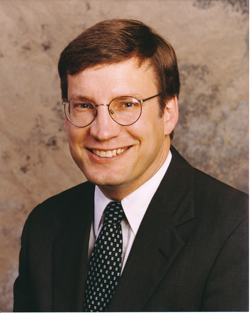
Commissioner Bradley A. Smith Bradley A. Smith was nominated to the Commission by President William Clinton on February 9, 2000, and confirmed by the U.S. Senate on May 24, 2000. He served as FEC Chairman in 2004.
Prior to his appointment, Smith was Professor of Law at Capital University Law School in Columbus, Ohio, where he taught Election Law, Comparative Election Law, Jurisprudence, Law & Economics, and Civil Procedure. Smith's writings on campaign finance and other election issues have appeared in the Yale Law Journal, the University of Pennsylvania Law Review, the Georgetown Law Journal, the Harvard Journal of Legislation, the Cornell Journal of Law & Public Policy, and other academic journals. As a law professor, Smith was a much sought-after witness in Congress on matters of campaign finance reform, and also a frequent guest on radio and television and a contributor to popular publications such as the Wall Street Journal and USA Today.
Prior to joining the faculty at Capital in 1993, he had practiced with the Columbus law firm of Vorys, Sater, Seymour & Pease, served as United States Vice Consul in Guayaquil, Ecuador, worked as a consultant in the health care field, and served as General Manager of the Small Business Association of Michigan, a position in which his responsibilities included management of the organization's political action committee.
Commissioner Smith received his B.A. cum laude from Kalamazoo College in Kalamazoo, Michigan and his J.D., cum laude, from Harvard Law School.
FEC introduces election cycle reporting for authorized committees
The Commission approved new regulations conforming to federal legislation that required authorized committees of federal candidates to aggregate and report receipts and disbursements on an election-cycle basis rather than on the traditional calendar-year basis. These revised regulations affect reports covering periods that begin on or after January 1, 2001. The new rules did not affect PACs or party committees.
FEC launches Administrative Fine Program
In response to a legislative mandate, an Administrative Fine Program was implemented in July 2000 to address late and non-filing of disclosure reports in a more efficient and effective manner. The AF Program is administered by the Commission's Reports Analysis Division (RAD) and Office of Administrative Review (OAR), which are within the Office of Compliance.
Commission certifies public funds for major party 2000 general election candidates and
The Commission certified $67.56 million each to the major party 2000 general election campaigns of Republican presidential nominee George W. Bush and his vice presidential running mate Richard Cheney (on August 4, 2000) and of Democratic presidential nominee Al Gore and his vice presidential running mate Senator Joseph Lieberman (on August 18, 2000).
Commission certifies funds to Reform Party 2000 general election campaign
On September 14, 2000, the Commission certified $12,613,452 million to the general election campaign of Reform Party candidate Pat Buchanan and his vice presidential running mate Ezola Foster.
Senate candidates' campaign finance reports made available on FEC website
In a joint effort by the U.S. Senate and the Commission to provide better public access to Senate campaign finance reports, the public can now view at the FEC website reports of money raised and spent by U.S. Senate candidates. Previously, Senate reports had been delivered by the Senate to the FEC on microfilm, which could not be transferred to quality images on the website.
Commission extends State Filing Waiver Program to U.S. Senate candidates
The Commission voted to extend the State Filing Waiver Program to include campaigns for U.S. Senate candidates and other political committees that support only U.S. Senate candidates.
Prior to the Commission's decision to extend the program, the state filing waiver did not apply to reports filed by candidates and committees whose point-of-entry for filing reports is the Office of the Secretary of the U. S. Senate.
Alternative Dispute Resolution program begins
The Commission established the Alternative Dispute Resolution Office (ADRO) as a pilot program to reduce enforcement case processing times and free up Commission resources.
Online submission of 48-Hour Notices debuts for the general election
The Commission developed a web-based filing system to enable candidate committees to create and submit their 48-Hour notices entirely online. Using the new system, even campaigns that did not file electronically and those that used software that did not generate the 48-Hour disclosure form (FEC Form 6) could file their 48-Hour Notices online.
Commission expands disclosure on its website
On October 18, 2000, the Commission announced several additions to its website to enhance campaign finance disclosure. As a result, individuals could now easily view summary statistical information about candidates, PACs and party committees on the FEC Website.
-
OCR-ready disclosure forms debut
The Commission issued new disclosure forms designed to be processed more quickly through the use of optical character recognition (OCR), in anticipation of the Commission's future use of this technology. The Commission made updated FEC forms 1, 2, 3, 3X, 3P, 6 and 8 available to committees filing in 2001. The changes to Forms 3 and 3P also adapted these forms for election-cycle reporting beginning January 2001.
Commission implements 1995 legislation concerning recordkeeping, reporting and filing
Over the last half of the 1990s, the Commission conducted several rulemakings that implemented late 1995 statutory changes to the reporting and recordkeeping provisions of the Act. The rulemakings concerned point of entry for FEC reports on the federal and state level, electronic filing by political committees, best efforts requirements for committee treasurers in obtaining, maintaining and submitting contributor information, and election-cycle reporting for authorized committees. These rules mostly remain in effect today.
FEC semi-finalist in ‘innovation’ competition
The Commission was named one of 99 semi-finalists from some 1,300 applicants in the “Innovations in American Government” award competition sponsored by the Ford Foundation and administered by Harvard University's John F. Kennedy School of Government.
The recognition highlights the success of the FEC's “State Filing Waiver Program.” Initiated in 1999, the program follows the letter of the law (Public Law 104-79; 1995) and enhances the spirit of it by eliminating the need for administration of paper filings of campaign reports at the state level, replacing that paper with electronic immediacy for public and media.
FEC v. Colorado Republican Federal Campaign Committee and
In 1996, the Supreme Court ruled that the Act's party coordinated expenditure limits at 52 U.S.C. § 30116(d) (then 2 U.S.C. § 441a(d)) cannot constitutionally be applied to a radio ad aired by a political party committee because the ad was not coordinated with any candidate and thus was an independent expenditure. In 2001, following remand of the matter, the Court held that those limits were constitutional.
Lawrence H. Norton serves as General Counsel -
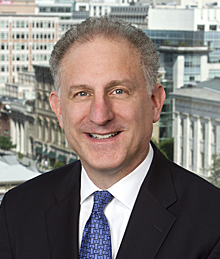
Lawrence H. Norton Lawrence Norton became General Counsel of the Commission on . Prior to joining the agency, Mr. Norton served as an Associate Director at the Commodity Futures Trading Commission for five years. He also worked as an Assistant Attorney General in the Maryland Attorney General's office. Mr. Norton graduated Order of the Coif from the University of Maryland School of Law.
-
Bipartisan Campaign Reform Act of 2002
The Bipartisan Campaign Reform Act (Pub. L. No. 107-55) (BCRA) contained a number of substantive changes to federal campaign finance law. It increased certain contribution limits and indexed them for inflation, banned the raising and spending of nonfederal funds by national party committees, required state party committees to pay for certain federal activity with 100 percent federal funds, created reporting requirements for persons making electioneering communications and prohibited corporations and labor unions from making them (a ban that is no longer in effect), strengthened the ban on foreign national contributions and increased penalties for knowing and willful violations. BCRA also added a “Millionaires' provision” which enabled candidates who were facing self-funded opponents to raise additional contributions once certain thresholds were met (no longer in effect). The BCRA also prohibited federal candidates and officeholders from raising or spending nonfederal funds in connection with any election, including for state/local candidates. It also authorized state/local party committees to raise “Levin funds” for the purpose of paying for certain types of generic activity such as voter registration and get-out-the-vote activity.
Michael E. Toner (R) serves as Commissioner -

Commissioner Michael E. Toner Michael E. Toner was nominated to the Commission by President George W. Bush on March 4, 2002 and appointed on March 29, 2002. Mr. Toner was confirmed by the United States Senate on March 18, 2003. He served as FEC Chairman in 2006.
Prior to being appointed to the FEC, Mr. Toner served as Chief Counsel of the Republican National Committee. Mr. Toner joined the RNC in 2001 after serving as General Counsel of the Bush-Cheney Transition Team in Washington, DC and General Counsel of the Bush-Cheney 2000 Presidential Campaign in Austin, TX.
Before joining the Bush campaign in Austin, Mr. Toner was Deputy Counsel at the RNC from 1997-1999. Prior to his tenure at the RNC, Mr. Toner served as Counsel to the Dole/Kemp Presidential Campaign in 1996.
Mr. Toner was an associate attorney at Wiley, Rein, & Fielding in Washington, DC from 1992-1996. His work there included advising political committees and corporate clients on federal and state election law compliance. He was also involved in a number of First and Fourteenth Amendment appellate litigation matters, including two cases that were successful in the U.S. Supreme Court.
Mr. Toner has written widely on campaign finance matters, including in the Washington Post, New York Times, Boston Globe, Chicago Tribune, Washington Times, The Hill, and Roll Call. Mr. Toner is a contributing author in the book “Divided States of America: The Slash and Burn Politics of the 2004 Presidential Election” (edited by Professor Larry J. Sabato, University of Virginia Center for Politics). Mr. Toner has also appeared as a guest commentator on Fox News Channel, Bloomberg News and C-SPAN.
Mr. Toner has served as an Adjunct Professor of Law at the William and Mary Law School and as a lecturer in the Department of Politics at the University of Virginia.
Mr. Toner received a J.D. cum laude from Cornell Law School in 1992, an M.A. in Political Science from Johns Hopkins University in 1989, and a B.A. with distinction from the University of Virginia in 1986. He is a member of the District of Columbia and Virginia bars, as well as the United States Supreme Court bar, the Fourth U.S. Circuit Court of Appeals, and the U.S. District Courts for the District of Columbia and the Eastern District of Virginia.
FEC launches BCRA web pages
As part of an extensive educational outreach effort, the Commission added a new section to its website devoted to the new Bipartisan Campaign Reform Act (BCRA).
Alternative Dispute Resolution Program becomes permanent
After a vote of the Commission, the Alternative Dispute Resolution Office, which had been a pilot program, became a permanent part of the FEC's enforcement process.
Ellen L. Weintraub (D) serves as Commissioner -
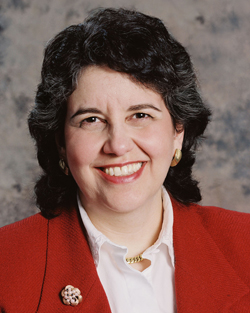
Commissioner Ellen L. Weintraub Ellen L. Weintraub took office as a Commissioner on December 9, 2002. After an initial recess appointment, her nomination was confirmed by unanimous consent of the United States Senate on March 18, 2003. Commissioner Weintraub served as Chair of the Commission four times, for calendar years 2003, 2013, 2019, and 2025.
Prior to her appointment, Ms. Weintraub was Of Counsel to Perkins Coie LLP and a member of its Political Law Group. There, she counseled clients on federal and state campaign finance and election laws, political ethics, nonprofit law, recounts, and lobbying regulation. During the election contest arising out of the 1996 election of Senator Mary Landrieu (D-LA), Ms. Weintraub served on the legal team that advised the Senate Rules Committee. Her tenure with Perkins Coie represented Ms. Weintraub's second stint in private practice, having previously practiced as a litigator with the New York law firm of Cahill Gordon & Reindel.
Before joining Perkins Coie, Ms. Weintraub was Counsel to the Committee on Standards of Official Conduct for the U.S. House of Representatives (the House Ethics Committee). Like the Commission, the Committee on Standards is a bipartisan body, evenly divided between Democratic and Republican members. Ms. Weintraub's work focused on implementing the Ethics Reform Act of 1989 and subsequent changes to the House Code of Official Conduct. She also served as editor in chief of the House Ethics Manual and as a principal contributor to the Senate Ethics Manual. While at the Committee, Ms. Weintraub counseled Members on investigations and often had lead responsibility for the Committee's public education and compliance initiatives.
Ms. Weintraub received her B.A., cum laude, from Yale College and her J.D. from Harvard Law School. A native New Yorker, she is a member of the New York and District of Columbia bars and the Supreme Court bar.
-
Commission issues “soft money” regulations
The Commission's first of seven rulemaking projects to implement the Bipartisan Campaign Reform Act of 2002 (BCRA) included regulations that restrict and, in some cases, ban the receipt, solicitation and use of nonfederal funds (sometimes called “soft money”). The rules prohibit national parties from raising or spending nonfederal funds; require state, district and local party committees to fund certain “federal election activities” with federal funds and, in some cases, with money raised according to new limitations, prohibitions and reporting requirements (i.e., “Levin funds”), or with a combination of such funds; and address fundraising by federal and nonfederal candidates and officeholders on behalf of party committees, other candidates and nonprofit organizations.
Commission adjusts contribution limits for inflation for the first time; certain contribution prohibitions are strengthened or enabled and
Contribution limits and prohibitions regulations that increased the individual contribution limits and implemented their regular indexing for inflation took effect on January 1, 2003. The Commission issued additional regulations, effective January 13, 2003, implementing BCRA's provisions that strengthened the foreign national ban and prohibited minors from making contributions (later removed, as explained in an later entry).
Commission addresses coordinated communications and independent expenditures in rulemakings and
Seeking to address various 1990s litigation results, the Commission promulgated a new definition of coordinated communications. The regulations became the subject of litigation in Shays I and Shays III, and were revised several times (see later entry).
Commission issues regulations on electioneering communications and other campaign communications , and
As part of its BCRA implementation, the Commission promulgated new rules on electioneering communications certain television and radio communications that refer to a clearly identified federal candidate and are publicly distributed to the relevant electorate within 60 of a general election or within 30 days of a primary election for Federal office. In other BCRA rulemakings, the Commission addressed the disclosure and disclaimer requirements (including BCRA's new design and wording requirements for disclaimers on print, television, and radio ads) for independent expenditure and electioneering communications.
FEC creates new disclosure forms and revises existing forms to implement BCRA
The Commission revised FEC Forms 1, 2, 3, 3X and 5 and their supporting Schedules and instructions to facilitate disclosure under the Bipartisan Campaign Reform Act of 2002 (BCRA). The revisions to Forms 1, 2, 3 and 3X primarily affect House and Senate campaigns and state, district and local political party committees, while the revisions to Form 5 affect individuals and qualified nonprofit corporations filing reports of independent expenditures. The Commission also created five new forms in order to implement various provisions of the BCRA:
* FEC Form 9, for use by individuals and qualified nonprofit corporations in reporting electioneering communications;
* FEC Forms 10, 11 and 12, incorporated various notices required of House and Senate campaigns under the Millionaires' Amendment. (Other notices required under that amendment were incorporated into Forms 3 and 3X Schedules.) The Millionaires' Amendment and resulting reporting requirements are no longer in effect after they were overturned by the Supreme Court.
* FEC Form 13, for use by inaugural committees. (This form was developed in 2004, after the others.)
Beaumont v. FEC
The Supreme Court upheld the Act's prohibition on contributions by corporations as applied to nonprofit advocacy corporations.
New procedures for RFAI letters
Analysts would now send only one letter requesting additional information, allowing respondents 30 days to reply (this has since been extended to 35 days). This is intended to prevent duplication and enable analysts more time to review reports. After receipt of the letter, the committee treasurer can make additions or corrections to the report, which are then added to the public record. Apparent violations, however, may be referred to the Audit Division, Alternative Dispute Resolution Office or to the Office of General Counsel for possible enforcement action. At this same time, the direct extensions of the assigned analysts were added to the letters to allow for better service to filers who need assistance.
Commission certifies public funds for major party 2004 presidential nominating conventions
On June 27, 2003, the Commission certified $14.592 million each to the convention committees of the Democratic and Republican parties for their 2004 presidential nominating conventions.
McConnell v. FEC
The Supreme Court upheld the two principal features of BCRA: the ban on raising and use of soft money in federal elections by political parties and the application of financing and disclosure rules to electioneering communications.
FEC launches system for searching closed enforcement cases
The Commission launched the Enforcement Query System (EQS) on the agency's website to improve public access to enforcement documents. The system was retired in 2024 and enforcement documents can now be accessed on the enforcement page
Enforcement disclosure policy approved
The Commission approved a Statement of Policy regarding disclosure of closed enforcement and related files that identified the categories of records that will be released to the public once enforcement cases are closed. The policy provided for the release of additional documents when enforcement cases were closed, including original complaints or internal FEC referrals that initiate enforcement actions, along with reports and briefs from the Office of General Counsel (OGC) and responses to those reports and briefs by respondents.
-
Commission initiates rulemaking on definition of political committee
The Commission undertook a rulemaking to revisit whether the definition of “political committee” adequately encompassed all organizations that should be considered political committees subject to the limitations, prohibitions and reporting requirements of FECA. The Commission held two days of public hearings in April 2004 and received roughly 100,000 written comments. The Commission ultimately decided not to define “major purpose” by regulation. (A supplemental notice published in 2007 explained that the Commission would make major purpose determinations on a case-by-case basis.) The Commission did adopt a new regulation that treated funds received in response to certain solicitations as “contributions,” counting toward an organization's threshold for registering as a political committee. That rule was repealed in 2010.
Commission certifies public funds for major party 2004 presidential general election candidates and
The Commission certified $74.62 million each to the major party 2004 general election campaigns of Republican presidential nominee President George W. Bush and his vice presidential running mate Vice President Richard Cheney (on September 2, 2004) and of Democratic presidential nominee Senator John Kerry and his vice presidential running mate Senator John Edwards (on July 30, 2004).
FEC launches updated website
Since the last major overhaul of the Commission's homepage in 1999, dramatic increases in the quantity of information available overwhelmed the existing site's structure and navigational tools. The new site featured more FEC information in a more user friendly format.
-
FEC introduces online version of court case abstracts
The Commission launched a new hypertext version of the FEC's Court Case Abstracts publication. This continuously-updated online index of FEC litigation replaced the paper publication that had typically been updated on an annual basis.
FEC publishes Thirty Year Report

Thirty Year Report The Commission published the Thirty Year Report to commemorate the Commission's 30-year anniversary.
BCRA challenge in McConnell v. FEC results in several rulemakings and
The Commission revised regulations that had governed two provisions of BCRA found unconstitutional by the Supreme Court in McConnell v. FEC: the ban on contributions from minors and the so-called “choice provision,” which prevented party committees from making both coordinated and independent expenditures on behalf of a candidate after that candidate's primary election. The Commission completed work on these rulemakings in 2004, reinstating pre-BCRA rules on contributions by minors (effective March 7, 2005) and clarifying that a party committee may make both coordinated and independent expenditures for general election candidates (effective December 3, 2004).
New rules on filing by Priority Mail, Express Mail and overnight delivery
The Commission approved final rules regarding the timely filing of documents using Priority Mail, Express Mail or overnight delivery service. The rules implemented FECA amendments included in the Consolidated Appropriations Act, 2005, that permitted filers to use these additional delivery options to satisfy the Commission's “timely filing” requirements for certain designations, reports and statements filed on paper with either the FEC or the Secretary of the Senate.
FEC introduces online filing via webforms
The FEC launched several webforms on its website, allowing for a quicker and easier way to file reports of last-minute contributions, independent expenditures and electioneering communications. The webforms included Forms 5, 6 and 9.
E-Review launched
In 2005, RAD, in coordination with the Information Technology Division, launched the first two phases of a web-based review system (Modules 1 and 2). The first two phases allow for greater sharing of information within the Division and outside it, increase management's ability to assign and track work, provide analysts with better control over work assignments and consolidate information about filing entities for easier access.
50th state certified for state filing waiver
Montana became the 50th state to be certified by the FEC as exempt from a federal requirement to receive and maintain paper copies of campaign finance reports from presidential, U.S. Senate and U.S. House of Representatives candidates, party committees and political action committees (PACs).
The State Filing Waiver Program began in 1999 with 12 states. After Montana was certified, among all states and territories only Guam and Puerto Rico were not in the waiver program.
-
Hans A. von Spakovsky (R) serves as Commissioner -

Commissioner Hans A. von Spakovsky Hans A. von Spakovsky was nominated to the Commission by President George W. Bush on December 15, 2005 and was appointed on January 4, 2006.
Prior to his appointment, Commissioner von Spakovsky served as Counsel to the Assistant Attorney General for Civil Rights in the U.S. Department of Justice, where he provided expertise and advice on voting and election issues, including of the Help America Vote Act of 2002.
Commissioner von Spakovsky has had a wide range of experiences in election related issues, including as a member of the first Board of Advisors of the U.S. Election Assistance Commission and the Fulton County Board of Registration and Elections, which administered elections in the largest county in Georgia. He served on the Voting Standards Committee of the Institute of Electrical and Electronics Engineers (IEEE) and on the Election and Voter Service Technical Committee of the Organization for the Advancement of Structured Information Standards (OASIS), which were developing standards for voting equipment and electronic data interchange.
Commissioner von Spakovsky is a past member of the Board of Advisors of the Georgia Public Policy Foundation, the Georgia Election Officials Association and the International Association of Clerks, Recorders, Election Officials and Treasurers. The Commission on Federal Election Reform organized by President Jimmy Carter and Secretary James Baker has also sought his expertise. Commissioner von Spakovsky has testified before state and congressional legislative committees and published articles on voter fraud, election reform, e-government, and Internet voting. He has appeared before numerous organizations including the National Association of Secretaries of State and the National Association of State Election Directors.
Prior to entering public service, Commissioner von Spakovsky worked as a government affairs consultant, in a corporate legal department, and in private practice. He received a J.D. from the Vanderbilt University School of Law in 1984 and a B.S. from the Massachusetts Institute of Technology in 1981. He is a member of the Georgia and Tennessee bars. He is a first-generation American whose parents immigrated to the United States in 1951. They met in a refugee camp as displaced persons after the end of World War II. He is originally from Huntsville, Alabama
Robert D. Lenhard (D) serves as Commissioner -

Commissioner Robert D. Lenhard Robert D. Lenhard was appointed to the Commission in 2006 and served as Chairman in 2007.
Prior to his appointment, Mr. Lenhard was an Associate General Counsel with the American Federation of State, County and Municipal Employees, AFL-CIO (AFSCME). At AFSCME, he was responsible for legal issues related to federal and state election laws. His work included counseling the union on federal and state campaign finance issues, litigating enforcement actions before the FEC and state agencies, and providing training to field staff on federal and state election law issues. Prior to becoming an Associate General Counsel at AFSCME, Mr. Lenhard was an associate at the law firm of Kirschner, Weinberg & Dempsey, where he represented AFSCME and other labor unions. Prior to that, Mr. Lenhard worked for the United Mine Workers of America (UMWA) and the Amalgamated Clothing and Textile Workers Union (ACTWU). After graduating from law school, Mr. Lenhard worked as an associate at the Los Angeles law firm of Grace, Neumeyer & Otto.
Mr. Lenhard is a 1981 graduate of the Johns Hopkins University where he earned a B.A. with Honors and a 1984 graduate of the University of California, Los Angeles School of Law.
Steven T. Walther (I) serves as Commissioner (1st appointment) -

Commissioner Steven T. Walther Steven T. Walther was first sworn in as an FEC Commissioner on January 10, 2006, as a recess appointee. Although his name was placed before the Senate for confirmation in June 2007, his recess term expired on December 31, 2007, before the Senate acted. On June 24, 2008, he was confirmed unanimously by the Senate and sworn in by Supreme Court Justice Ruth Bader Ginsburg on June 27, to resume the balance of his statutory term. Mr. Walther served as Vice Chairman of the FEC for the balance of 2008 and served as the Commission's Chairman in 2009 and 2017.
Prior to joining the FEC as a Commissioner, Mr. Walther practiced law in the Reno, Nevada law firm of Walther, Key, Maupin, Oats, Cox & LeGoy, now known as Maupin, Cox & LeGoy which he co-founded in 1972.
During his legal career Mr. Walther has been active in professional legal and judicial organizations and activities, as well as numerous civic activities. He is a former member of the Board of Governors of the American Bar Association and currently serves as co-chair of the ABA Center for Human Rights. He has been active in ABA initiatives focusing on international relations, human rights and the rule of law. He was appointed by the ABA President to serve as the ABA Representative to the United Nations. He served on the Executive Board of the ABA Central European and Eurasian Law Initiative (CEELI), which oversees the ABA's democracy building programs in over 21 countries -- programs, which promote development of fair and open election laws. He has been a member of the Board of Trustees and lecturer for the National Judicial College, both in the United States and in Russia. Mr. Walther has lectured extensively, both domestically and internationally (principally in Russia), on rule of law, human rights, litigation and international law issues. He is a member of the American Law Institute and the International Bar Association.
Mr. Walther is a former president of the State Bar of Nevada, the Western States Bar Conference, and the National Caucus of State Bar Associations. He is a past chair of the 6,000 member Fellows of the American Bar Foundation, the legal research arm of the ABA. From 1971 until his FEC appointment, Mr. Walther served as a member of the Nevada State Advisory Committee to the U.S. Commission on Civil Rights.
He received his J.D. degree from Boalt Hall School of Law, University of California, Berkeley in 1968, and recently served as president of the Boalt Hall Alumni Association. He received his undergraduate degree, with a major in Russian, from the University of Notre Dame, Notre Dame, Indiana, in 1965.
FEC makes audio recordings of Commission meetings available on website via podcast
The FEC began posting to its website the audio recordings of all public Commission meetings. Recordings are available both as complete meeting audio files and as individual agenda item audio files. The FEC originally committed to making these recordings available within 48 hours, but reduced that to 24 hours in 2012. Today, it's not unusual for the recordings to be available the same day as the event.
Budget cuts force FEC to cancel spring conferences
The Commission announced that budget constraints would force it to cancel its educational outreach conferences planned for the spring of 2006.
FEC upgrades website search process
The FEC launched a new search process on its website that offered several new features. The key match feature, for example, highlighted some of the pages that are viewed most often and listed them first in the search results. Other features suggested synonymous search terms and spelling alternatives that helped to improve results.
Commission levies record fine against Freddie Mac for FECA violations
The Commission entered into a conciliation agreement with Federal Home Loan Mortgage Corporation (Freddie Mac), a federally chartered corporation, concerning its use of corporate resources to host campaign fundraising events and to collect and forward political contributions to federal candidates. The $3.8 million civil penalty Freddie Mac agreed to pay for these violations is the highest civil penalty in FEC history.
Commission adopts internet regulations that create exemptions for voluntary individual internet activities
After the court in Shays I ruled in 2004 that the FEC's definition of “public communication” impermissibly excluded all internet communications, the Commission amended the definition to include only paid internet ads placed on another person's website. The Commission further amended its regulations governing disclaimers and definitions of “contribution” and “expenditure” “to ensure that political committees properly financed and disclosed their internet communications, without impeding individual citizens from using the internet to speak freely regarding candidates and elections.”
Commission introduces Tips for Treasurers webpage and RSS feed
The FEC posted a new Tips for Treasurers web page and RSS feed designed to keep treasurers updated on the latest FEC compliance information.
Patrina M. Clark serves as Staff Director -

Patrina Clark On July 10, 2006, Patrina M. Clark began her tenure as Staff Director of the Commission, succeeding Acting Staff Director Robert Costa. Prior to her appointment, Ms. Clark served as Regional Executive Director for Naval District Washington. As the senior civilian official in the region, she managed the Human Resources, Information Technology, Comptroller and Public Affairs offices, among other activities. Before her service with the Department of the Navy, she held a number of key positions with the Internal Revenue Service, most recently as Director, Cooperative Efforts and Strategic Support. A Texas native, Ms. Clark began her undergraduate studies at the University of Texas as a National Merit Scholar and University of Texas Presidential Scholar. She completed her undergraduate studies at Thomas Edison State College with an emphasis in Communications and Human Resources Management. Ms. Clark has a graduate certificate from the Cornell University School of Industrial Labor Relations in Human Resources Management and a Master's Certificate in Project Management from George Washington University (GWU). She was awarded a joint certificate in Advanced Public Policy Leadership from the Brookings Institution and GWU, and is a graduate of GWU's Senior Executive Development Program. She completed Georgetown University's Senior Executive Leadership Continuing Studies Certificate Program and is certified as a Senior Human Resources Professional by the Human Resources Certification Institute.
FEC establishes Office of Compliance during enforcement restructuring
The Office of Compliance was established as part of a high-level restructuring of the Office of the Staff Director. The Compliance Office was set up with four branches: the Alternative Dispute Resolution Office, the Audit Division, the Office of Administrative Review and the Reports Analysis Division.
-
Commission replaces paper mailings with email
The Commission announced that it would send all courtesy materials to committees exclusively by electronic mail. The switch from paper to electronic mail was intended to improve the timeliness of communications with committees, offer opportunities for new types of communications and simplify the process of providing information tailored specifically to each committee's needs, all while saving tax dollars.
Revised Continuing Appropriations Act Resolution, 2007
This legislation (Pub. L. No. 110-5) granted the Commission authority to charge fees for conferences and workshops and to use those fees to defray conference costs.
Commission adopts “best efforts” defense for administrative fines challenges
The Commission voted to revise its rules to allow committees to use “best efforts” as a defense for challenges in the Administrative Fine Program. To use best efforts as a defense, respondents must demonstrate that they could not file due to reasonably unforeseen circumstances beyond their control, and that they filed the late report within 24 hours after those circumstances ended.
Guidance on internal controls and preventing embezzlement
The Commission published guidance for political committees on best practices in setting up internal controls to prevent embezzlement, as well as a statement of policy on reporting errors caused due to misappropriation of funds by committee staff.
Thomasenia Duncan serves as General Counsel -

Thomasenia (Tommie) Duncan General Counsel Thomasenia (Tommie) Duncan served three years as FEC General Counsel and three years as Associate General Counsel for General Law and Advice. Prior to joining the Commission in February of 2004, Duncan was General Counsel for America's Promise The Alliance for Youth. She continues a distinguished career in government service, including having served as General Counsel of the Corporation for National and Community Service. She began the practice of law with the firm Covington & Burling LLP. Ms. Duncan is a graduate of Brown University and the University of Pennsylvania Law School, and also attended Yale University Law School.
Presidential campaign finance map debuts
The FEC introduced an interactive map on its website that displays individual contributions to presidential candidates, starting with the 2008 election. With a simple click of the mouse, a user could highlight on the map the amount of money raised on a state-by-state basis. Users also had the option of viewing contributions to specific candidates, all candidates or all candidates from a political party. The map conveniently displayed the total contributions to each candidate, along with their cash on hand and the distribution of their contributions by amount.
Wisconsin Right to Life, Inc. (WRTL) v. FEC
The Supreme Court ruled that the electioneering communication financing restrictions were unconstitutional as applied to communications that do not contain express advocacy or its functional equivalent.
Commission certifies public funds for major party 2008 presidential nominating conventions
On June 27, 2007, the Commission certified $16.356 million each to each major party's 2008 national convention committee for the party's Presidential nominating convention.
Automated email updates

The Commission launched FECMail, a web-based email service that provided subscribers automatic updates on a variety of campaign finance topics. The new service allowed users to sign-up to receive notification whenever information important to them was added or changed on the Commission's website.
Honest Leadership and Open Government Act of 2007
The Honest Leadership and Open Government Act of 2007 (Pub. L. No. 110-81)(HLOGA) restricted use of non-commercial aircraft by candidates and federal officeholders, and also required disclosure of contributions raised or bundled by registered lobbyists or PACs controlled by registered lobbyists.
FEC introduces online map to track U.S. Senate and House campaign finances
An interactive online map unveiled in 2008, uses state and district maps to lead the user to campaign finance data for House and Senate candidates, starting with the 2007-2008 cycle. It allows the user to select candidates for comparison using bar charts to display such financial categories as contribution and disbursement totals, debts and cash-on-hand. It also presents itemized contributions and disbursements by category and includes links to images of reports filed by the candidate and the candidate's committees.
Regulations implement Supreme Court decision in FEC v. Wisconsin Right to Life
The Commission revised its regulations following the Supreme Court's ruling in FEC v. Wisconsin Right to Life, Inc. (2007) to state that electioneering communications similar to those in WRTL may be funded with corporate and/or labor funds, but are subject to reporting and disclaimer requirements. The Commission's 2007 regulations included a provision that required corporations or labor organizations that made WRTL-permitted electioneering communications to disclose the name and address of each person who made a donation aggregating $1,000 or more to the corporation or labor organization “for the purpose of furthering electioneering communications.” In November 2014, this particular provision was vacated by the U.S. District Court for the District of Columbia in Van Hollen v. FEC.
Recess appointments of three FEC Commissioners expire
Recess appointments of three FEC Commissioners expire at the end of 2007 without Senate confirmation, leaving four seats on the Commission vacant.
-
FEC launches enhanced presidential campaign finance map
The Commission introduced an improved version of its presidential Campaign Finance map. Available on the FEC website, the map includes detailed information on each candidate's campaign expenditures. It also provides a number of enhanced viewing and searching options for information about campaign contributors. These improved features were included on similar maps for U.S. House and Senate campaigns.
Shays v. FEC (Shays III)
The DC Circuit Court of Appeals remanded several coordination and FEA regulations to the Commission for further rulemaking. The court also upheld the firewall safe harbor for coordination by former employees and vendors. The court overturned regulations permitting federal candidates to solicit funds without restriction at state or local party events.
Obama becomes first major party candidate to forego public funds in general election
Senator Barack Obama announced that he would not participate in the public financing system for presidential campaigns in the general election. With his decision, Mr. Obama became the first candidate of a major party to decline public financing in the general election - and the spending limits that go with it - since the system was created in 1976.
Davis v. FEC
The Supreme Court ruled that the Millionaires' Amendment included in BCRA violated the First Amendment rights of self-financed federal candidates.
Cynthia L. Bauerly (D) serves as Commissioner -

Commissioner Cynthia L. Bauerly Cynthia L. Bauerly joined the Commission in 2008 after her appointment received the unanimous consent of the United States Senate. She served as the Commission's Chair during 2011 and as the Commission's Vice Chair for the year 2010. She left the Commission on February 1, 2013.
Commissioner Bauerly has extensive experience in law and public policy, particularly in the areas of election administration, campaign finance, ethics reform, technology, and intellectual property. Prior to her appointment to the Commission, Ms. Bauerly served as Legislative Director for United States Senator Charles E. Schumer of New York. She previously served as counsel on the Senate Judiciary and Rules Committees.
Commissioner Bauerly has also worked in private practice in Minnesota and Washington, DC, specializing in complex litigation and appellate law, with a focus on intellectual property.
Originally from Minnesota, Commissioner Bauerly is a summa cum laude graduate of Concordia College in Moorhead, Minnesota. She graduated cum laude from Indiana University School of Law-Bloomington and received a Master of Public Affairs from Indiana University's School of Environmental and Public Affairs. She served as a judicial clerk for the Honorable Florence-Marie Cooper of the United States District Court for the Central District of California and the Honorable Theodore R. Boehm of the Indiana Supreme Court.
Steven T. Walther (I) serves as Commissioner (2nd appointment) -
Commissioner Steven T. Walther Steven T. Walther was first sworn in as an FEC Commissioner on January 10, 2006 as a recess appointee. Although his name was placed before the Senate for confirmation in June 2007, his recess term expired on December 31, 2007, before the Senate acted. On June 24, 2008, he was confirmed unanimously by the Senate and sworn in by Supreme Court Justice Ruth Bader Ginsburg on June 27, to resume the balance of his statutory term. Mr. Walther served as Vice Chairman of the FEC for the balance of 2008 and served as the Commission's Chairman in 2009 and 2017.
Prior to joining the FEC as a Commissioner, Mr. Walther practiced law in the Reno, Nevada law firm of Walther, Key, Maupin, Oats, Cox & LeGoy, now known as Maupin, Cox & LeGoy which he co-founded in 1972.
During his legal career Mr. Walther has been active in professional legal and judicial organizations and activities, as well as numerous civic activities. He is a former member of the Board of Governors of the American Bar Association and currently serves as co-chair of the ABA Center for Human Rights. He has been active in ABA initiatives focusing on international relations, human rights and the rule of law. He was appointed by the ABA President to serve as the ABA Representative to the United Nations. He served on the Executive Board of the ABA Central European and Eurasian Law Initiative (CEELI), which oversees the ABA's democracy building programs in over 21 countries' programs which promote development of fair and open election laws. He has been a member of the Board of Trustees and lecturer for the National Judicial College, both in the United States and in Russia. Mr. Walther has lectured extensively, both domestically and internationally (principally in Russia), on rule of law, human rights, litigation and international law issues. He is a member of the American Law Institute and the International Bar Association.
Mr. Walther is a former president of the State Bar of Nevada, the Western States Bar Conference, and the National Caucus of State Bar Associations. He is a past chair of the 6,000 member Fellows of the American Bar Foundation, the legal research arm of the ABA. From 1971 until his FEC appointment, Mr. Walther served as a member of the Nevada State Advisory Committee to the U.S. Commission on Civil Rights.
He received his J.D. degree from Boalt Hall School of Law, University of California, Berkeley in 1968, and recently served as president of the Boalt Hall Alumni Association. He received his undergraduate degree, with a major in Russian, from the University of Notre Dame, Notre Dame, Indiana, in 1965.
Donald F. McGahn II (R) serves as Commissioner -
Donald McGahn was sworn into office as an FEC Commissioner on July 9, 2008. Nominated by President Bush on May 6, his appointment received the unanimous consent of the United States Senate on June 24, 2008. He was elected Chairman on July 10, 2008, and served in that capacity for the balance of the calendar year.
Prior to his appointment to the Commission, Mr. McGahn served as head of McGahn & Associates PLLC, a Washington-based law practice specializing in election law. Mr. McGahn has represented federal and state candidates, Members of Congress, political party committees, leadership political action committees (PACs), corporations and corporate PACs, non-profits, trade associations and others involved in issues related to campaign finance law and government ethics. Since 1999, Mr. McGahn served as General Counsel to the National Republican Congressional Committee. He also served as Counsel for the Illinois Republican Party for several years.
Before joining the NRCC, Mr. McGahn practiced law at Patton Boggs LLP in Washington, DC. As a member of the firm's litigation group, he advised and represented elected officials, candidates, national and state parties and others on election law issues. Mr. McGahn has been recognized for his significant pro bono work for the Lawyers' Committee for Civil Rights Under Law. Prior to Patton Boggs LLP, Mr. McGahn served as a judicial law clerk to the Honorable Charles R. Alexander of the Court of Common Pleas in Pennsylvania.
Mr. McGahn attended the United States Naval Academy, the University of Notre Dame, Widener University School of Law and the Georgetown University Law Center.
Caroline C. Hunter (R) serves as Commissioner -

Commissioner Caroline C. Hunter Commissioner Caroline C. Hunter was nominated to the Commission by President George W. Bush on May 6, 2008. Her appointment was approved by the United States Senate on June 24, 2008.
Ms. Hunter previously served as the Vice-Chair of the U.S. Election Assistance Commission. Ms Hunter was nominated to the EAC in 2006 and confirmed by the U.S. Senate on February 15, 2007.
Ms. Hunter previously served as deputy director of the White House Office of Public Liaison from January to October 2006. From 2005 to 2006, she served as executive officer at the U.S. Department of Homeland Security, Office of Citizenship and Immigration Services Ombudsman.
From 2001 to 2005 she was associate counsel and then deputy counsel at the Republican National Committee where she provided guidance on election law and the implementation of the Help America Vote Act.
Ms. Hunter graduated cum laude from the University of Memphis School of Law and received her bachelor of arts degree from The Pennsylvania State University.
Matthew S. Petersen (R) Serves as Commissioner -

Commissioner Matthew S. Petersen Matthew S. Petersen was nominated to the Commission by President George W. Bush on June 12, 2008, and unanimously confirmed by the United States Senate on June 24, 2008. He served as Chairman of the Commission in 2010 and 2016.
From 2005 until his appointment to the Commission, Mr. Petersen served as Republican chief counsel to the U.S. Senate Committee on Rules and Administration. In this capacity, Mr. Petersen provided counsel on issues relating to federal campaign finance and election administration laws as well as the Standing Rules of the Senate.
Prior to this, Mr. Petersen served as counsel to the U.S. House of Representatives Committee on House Administration. During his tenure, Mr. Petersen was extensively involved in the crafting of the Help America Vote Act of 2002 ("HAVA") and the House-Senate negotiations that culminated in HAVA's passage. From 1999 to 2002, Mr. Petersen specialized in election and campaign finance law at the law firm of Wiley Rein LLP in Washington, DC
Mr. Petersen received his J.D. in 1999 from the University of Virginia School of Law, where he was a member of the Virginia Law Review. He graduated magna cum laude with a B.A. in philosophy from Brigham Young University in 1996. He also received an A.S. with high honors from Utah Valley State College.
-
Commission removes unconstitutional “Millionaires' Amendment” regulations
In February 2009, the Commission removed 2003 regulations that had implemented BCRA's so-called “Millionaires' Amendment.” This provision increased contribution limits and coordinated party expenditure limits for Senate and House of Representative candidates facing self-financed opponents. The “Millionaires' Amendment” had been found unconstitutional in Davis v. FEC.
FEC implements lobbyist bundling disclosure requirements
The Commission approved regulations to conform to the provisions of the Honest Leadership and Open Government Act of 2007, which mandated enhanced disclosure for lobbyist-bundled contributions. A new form, FEC Form 3L, was created to conform to the new reporting requirements. The FEC also set up a new database of lobbyist-registrant PACs.
Robert A. Hickey serves as Staff Director -

Robert Hickey Robert A. Hickey became Staff Director in February 2009, after serving in a number of senior positions in the government including Chief of Staff at the National Intelligence University.
Mr. Hickey succeeded Joseph Stoltz, the head of the Commission's Audit Division, who had served as Acting Staff Director since August 2008. Mr. Hickey served in the U.S. Air Force and as a pilot for American Airlines before joining Booz Allen Hamilton. He returned to government service, serving in the Office of the Director of National Intelligence and then helping launch the National Intelligence University.
Mr. Hickey graduated with a bachelor's degree in American History from the U. S. Air Force Academy and a master's degree in International Affairs from Oklahoma University.
FEC launches lobbyist bundling web page
The Commission added a new page to its website to aid compliance with the lobbyist bundling disclosure provisions of the Honest Leadership and Government Act of 2007 (HLOGA).
Press Office introduces Weekly Digest
The FEC Press Office published its first Weekly Digest summarizing FEC news.
Website improvement hearings
In July and August 2009, the Commission held public hearings to receive comments on proposed website improvements as part of its Website and Internet Communications Improvement Initiative. The Commission was pursuing several programs to update and improve its website, enable the agency to keep pace with the latest technological developments and facilitate greater information sharing, communication and collaboration on the web.
Electronic distribution of FEC Record begins
The Commission stopped mailing paper copies of its FEC Record newsletter and started distributing it electronically. Electronic distribution was designed to improve efficiency, conserve resources and provide more timely delivery to subscribers.
Commission adopts audit hearing procedures
The Commission instituted a program that allows political committees to have a hearing before the Commission prior to the Commission's adoption of a Final Audit Report on the matter. The audit hearings were aimed at providing audited committees with the opportunity to present oral arguments to the Commission directly and to give the Commission an opportunity to ask relevant questions prior to adopting a Final Audit Report.
FEC launches E-Learning and FECTube web pages
As part of its broad effort to improve Internet communications and better serve the educational needs of the public and the regulated community, the Commission added an E-Learning section to its Educational Outreach web page and launched its own YouTube channel. The E-Learning page offered interactive presentations that allowed users to test their knowledge of the information presented and video workshops, which were hosted on YouTube.
EMILY's List v. FEC
The D.C. Circuit struck down FEC regulations on how nonconnected PACs allocate funds to finance certain federal and nonfederal election activities, stating that such entities could collect unlimited funds from individuals and nonprofits to make independent expenditures.
FEC expands disclosure of litigation documents
The Commission approved a proposal to disclose pleadings from all parties involved in FEC litigation, including documents filed by adverse parties and amici, on its website. The inclusion of a wider range of documents on the FEC's litigation pages is intended to help the public better understand the impact of litigation and is part of the Commission's effort to promote transparency.
FEC introduces new formats for downloading data files, disclosure data blog
The Commission introduced new formats, known as the Data Catalog, for downloading data files from its website that allowed users increased flexibility and choice to customize their searches. The Commission also began a new disclosure data blog to increase the exchange of information between the website's managers and users.
-
Citizens United v. FEC
The Supreme Court held that the Act's prohibitions on corporations making independent expenditures and electioneering communications violated the First Amendment; however, the Court upheld applicable reporting and disclaimer requirements.
FEC introduces new compliance map
The Commission introduced a Compliance Map on its website that set out key dates and timeframes for disclosure of campaign finances in each state. This feature provided a quick reference for citizens and for the candidates, party committees and political action committees participating in elections.
SpeechNow.org v. FEC
The D.C. Circuit held that the Act's limits on the amounts that individuals may contribute to groups that make only independent expenditures violated the First Amendment; however, the Court upheld the organizational and reporting requirements that apply to such political committees.
Commission amends allocation rules and definition of a political committee to conform with EMILY's List (regulation implemented); (regulation removed)
The Commission removed a regulation that treated funds received in response to certain solicitations as “contributions,” counting toward an organization's threshold for registering as a political committee, as well as two regulations concerning allocation of expenses by PACs, after the Court of Appeals for the District of Columbia vacated it in EMILY's List v. FEC (2009).
FEC website provides new candidate disbursements feature
The Commission introduced a new Candidate Disbursements feature on its website, which provided downloads of itemized disbursements reported by U.S. House and Senate candidate committees for the 2010 election cycle. Although disbursement data for House candidates had been previously downloadable from the FEC's website, this new feature provided the public with an easy-to-use, one-step tool for accessing data that up to now had taken several steps to put in searchable form. This also marked the first time that the public had the ability to download Senate candidate data electronically.
Shays III revisions to final rules on participation by federal candidates and officeholders in nonfederal fundraising events take effect
The Commission approved final rules that cover participation by federal candidates and officeholders at fundraising events that are in connection with an election for federal office or any nonfederal election where funds outside the amount limitations and source prohibitions of federal campaign finance law are solicited. The rule addresses participation at the fundraising event and in publicizing the event.
Regulations to implement the Honest Leadership and Government Act (HLOGA) of 2007 (lobbyist bundling); (campaign travel); and (revisions to presidential travel regulation)
Following the passage of HLOGA, the FEC completed two rulemakings that (1) implemented HLOGA's disclosure requirements for certain committees that receive bundled contributions from lobbyists and committees established or controlled by any lobbyist and (2) established new rules relating to travel on private jets by candidates and other “campaign travelers.”
FEC announces new search system for audit reports
The Commission launched a new search system for accessing audit reports on its website. The Audit Finding Search System allowed users to search all approved audit reports using a two-level listing of categories that helped users narrow their research to the most relevant documents. The results displayed all documents pertaining to the audit report.
FEC offers real-time, searchable information on independent expenditures
The Commission introduced a new, searchable feature on its website allowing real-time, comprehensive disclosure of independent expenditures in the 2010 federal campaign. This new feature was part of a far-reaching effort by the agency to expand the use of searchable, sortable and downloadable data technologies to provide timely information to the public.
Shays III revisions to final rules on coordinated communications take effect
The 2010 revisions to the coordinated communications regulations added a “content standard” for communications that are the “functional equivalent of express advocacy.” The new rules also created a safe harbor for certain business and commercial communications, and provided further explanation and justification for two “conduct standards” in the existing regulations.
Shays III revisions to final rules on “Federal Election Activities” take effect
The Commission modified the definitions of “voter registration activity” and “get-out-the-vote-activity” (GOTV activity) and made other changes in response to the Shays III decision.
-
Reports Analysis Division launches automated letter generation system phase of E-Review
The new system automated the creation, approval, and imaging of RFAIs for the public record. This web-based application that allows the analyst to create RFAIs that can then be automatically submitted to a manager for approval and placed on the FEC website.
FEC announces new search system for rulemaking documents
The Searchable Electronic Rulemaking System allowed users to search public documents developed in the course of the Commission's rulemaking process. This system, which could be searched chronologically, by subject or regulation name or number, replaced and expanded upon the Commission's former online rulemaking archive. It also provided a new mechanism for the public to comment on ongoing rulemakings.
Anthony Herman serves as General Counsel -

Anthony Herman Anthony Herman became General Counsel for the Commission in June 2011. During his tenure as the Commission's General Counsel, Herman led a staff of approximately 115 employees and spearheaded the reorganization of the Office of General Counsel, which is composed of the Divisions of the Deputy General Counsel for Administration, the Deputy General Counsel for Law, as well as the Divisions of Enforcement, Litigation and Policy. Herman came to the Commission from Covington & Burling LLP, where he was a senior litigation partner and served as chair of the firm's Public Service Committee.
Herman received a B.A. from the University of South Carolina and a J.D. magna cum laude from Harvard Law School. After law school, he served as a law clerk in the United States Court of Appeals for the Fifth Circuit to the Hon. Irving L. Goldberg and taught constitutional law, and other courses, as a law professor at Florida State University College of Law.
FEC Record newsletter becomes online news site
In an effort to provide more timely and user-friendly information, the Commission converted the Record from a print-based online publication to a wholly web-based format that better utilizes the medium.
Alec Palmer serves as Staff Director - present

Alec Palmer Staff Director The Commission named D. Alec Palmer to be the agency's new Staff Director. Palmer, who served as Acting Staff Director, also will continue his responsibilities as the agency's Chief Information Officer (CIO).
Palmer came to the Commission in 2003 as CIO. In that role, he has created new information technology initiatives that were designed to improve the agency's operating efficiency along with its disclosure and transparency practices. He drove efforts that allowed for the development of new website tools including the addition of the popular campaign finance maps to the Commission's website, the real-time disclosure of independent expenditures, publishing of enforcement case files dating back to 1975, the expansion of the advisory opinion search feature and a new searchable rulemaking system.
Prior to joining the Commission, Palmer had 15 years of CIO experience, and has provided leadership to senior management professionals in the public service, hospitality, oil and gas, high-tech manufacturing, financial services, publishing and healthcare industries. Alec received his bachelor's degree from Brigham Young University.
As Staff Director, Palmer serves as the chief administration and management officer for more than 350 employees and six Commissioners. The position is one of three statutory positions at the Commission.
Carey v. FEC
The FEC entered into a consent judgement stating that it would no longer enforce provisions of the Act against nonconnected political committees that wished to accept contributions of unlimited amounts, deposit such contributions into a separate “Non-Contribution Account,” and use those funds to finance independent expenditures.
Reports Analysis Division begins emailing RFAIs
The Reports Analysis Division implemented a process to send Requests for Additional Information (RFAIs) via email, to provide faster and more convenient notification to committees.
Commission certifies public funds for major party 2012 presidential nominating conventions
On November 8, 2011, the Commission certified $17,689,800 each to each major party's 2012 national convention committee for the party's presidential nominating convention.
Beta mobile interface
FEC Mobile Beta Website The FEC released the first in a series of FEC Mobile beta web pages designed to run on mobile devices. These beta web pages provided easier public access to campaign finance data and information about Commission activities.
-
RAD launches FAQ web page
The Reports Analysis Division posted a web page to answer frequently asked questions (FAQ's) about reporting issues, Requests for Additional Information (RFAI's) and other RAD processes.
FEC launches new campaign finance disclosure website portal
The Commission introduced a new campaign finance disclosure portal to simplify access to the wide range of disclosure data available on the agency's website.
The disclosure portal provided a single point of entry to federal campaign finance data. It featured easily navigable maps, as well as a variety of search tools to help users make the best use of the Commission's data sources. Users could download many of the data sets available through the Disclosure Portal to perform their own analyses.
FEC releases documents on enforcement and compliance practices
The Commission made public a collection of internal documents concerning the agency's enforcement and compliance practices. Disclosure of the documents followed oversight hearings on November 3, 2011before the Subcommittee on Elections of the House of Representatives Committee on House Administration.
RAD Review and Referral Procedures made public
RAD makes its determinations for sending RFAIs and referring a committee for further action based on Commission-approved thresholds contained in the RAD Review and Referral Procedures. This and other documents describing the agency's policies and procedures were made public, subject to limited redactions, following an oversight hearing on November 3, 2011 before the Subcommittee on Elections of the House of Representatives Committee on House Administration.
Two new disclosure tools unveiled
The FEC introduced the Candidate and Committee Viewer search system to simplify access to campaign finance data. The Viewer allowed users to find campaign finance activity of any federal candidate, political committee, independent expenditure report filer or other report filer through a single search portal instead of conducting multiple searches in different databases on the website. The Viewer brought together cycle-to-date summaries, report summaries, images of reports and statements and downloadable electronic filings to produce an overview of each committee, and it provided both dynamic graphic charts and complete data sets in a downloadable, spreadsheet format to allow users to drill down to and analyze specific transactions. An introductory video provided an overview of the Viewer's main features.
The Commission also updated its Electronic Filing RSS feed to notify subscribers when a filer has sent a new report or document electronically to the Commission. Users could subscribe to six pre-established RSS (Really Simple Syndication) feeds: new electronic filings, monthly filings, quarterly filings, presidential filings, congressional filings and PAC and party filings. Alternatively, subscribers could customize their feeds by committee identification number, state or district. Additional subscription options were based on filers' party affiliation and report type. An online user guide offered further guidance on using the RSS feed.
-
Online E-Filing password system Developed
The Commission developed and implemented a self-assigning password system. The system allows committees to request or change an electronic filing password online, automating the prior process of submitting password requests via fax or mail.
Press Office upgrades media web page
The revamped Press Office page was designed to help the public, including researchers, academics and media, find information on the Commission and campaign finance law and to locate statistical data more quickly and easily.
Lee E. Goodman (R) Serves as Commissioner -

Commissioner Lee E. Goodman Lee E. Goodman was appointed to the Commission by President Barack Obama on October 21, 2013, and sworn into office on October 22, 2013. President Obama nominated Commissioner Goodman, a Republican, on June 24, 2013, on the recommendation of Senator Mitch McConnell and he was confirmed by unanimous consent of the United States Senate on September 23, 2013. Commissioner Goodman served as Chairman of the Commission in 2014 and Vice Chairman in 2013.
Prior to joining the Commission, Mr. Goodman practiced election law in private practice for the better part of two decades and served in a number of governmental and political posts. In private practice, he represented candidates, public officials, political parties, political action committees, non-profit organizations, and media companies in addressing a wide range of laws regulating their political activities and speech. He advised four presidential campaigns from 2007 to 2012. He served as general counsel of the Republican Party of Virginia (2009-2013). He also represented non-political clients in addressing other regulatory and public policy issues.
His prior government service includes four years as legal counsel and policy advisor to the Governor of Virginia (1998-2002) and three years as counsel and special assistant to the Attorney General of Virginia (1995-1997). He served as chief advisor to the Chairman of the Congressional Advisory Commission on Electronic Commerce (1999-2000).
Mr. Goodman has authored several articles on election law, including a chapter on regulation of political speech on the Internet in the book Law and Election Politics - The Rules of the Game (Routledge 2013), and he has lectured frequently on election law topics. He has served on the boards of several political, educational and cultural non-profit organizations. He is recognized as a national expert in close elections, recounts and election administration.
He received his B.A. with highest distinction in 1986 from the University of Virginia, where he double majored in American government and rhetoric & communication studies. He received his J.D. in 1990 from the University of Virginia School of Law, where he served as Articles Editor for the U.Va. Journal of Law & Politics.
Ann Ravel (D) serves as Commissioner -

Commissioner Ann Ravel Commissioner An Ravel was nominated to the Commission by President Barack Obama on June 21, 2013. After her appointment received the unanimous consent of the United States Senate, Ms. Ravel joined the Commission on October 25, 2013. She served as Vice Chair for 2014 and Chair for 2015.
From March 2011 until her appointment to the Commission, Ms. Ravel served as Chair of the California Fair Political Practices Commission (FPPC), to which Governor Edmund G. Brown, Jr. appointed her. At the FPPC, Ms. Ravel oversaw the regulation of campaign finance, lobbyist registration and reporting, and ethics and conflicts of interest related to officeholders and public employees. During her tenure at the FPPC, Ms. Ravel was instrumental in the creation of the States' Unified Network (SUN) Center, a web-based center for sharing information on campaign finance.
Before joining the FPPC, Ms. Ravel served as Deputy Assistant Attorney General for Torts and Consumer Litigation in the Civil Division of the United States Department of Justice. Ms. Ravel also worked as an attorney in the Santa Clara County Counsel's Office, ultimately serving as the appointed County Counsel from 1998 until 2009. Ms. Ravel represented the County and its elected officials, provided advice on the state Political Reform Act, and initiated groundbreaking programs in elder abuse litigation, educational rights, and consumer litigation on behalf of the Santa Clara County government and the community.
Ms. Ravel has served as an elected Governor on the Board of Governors of the State Bar of California, a member of the Judicial Council of the State of California, and Chair of the Commission on Judicial Nominees Evaluation. In 2007, the State Bar of California named Ms. Ravel Public Attorney of the Year for her contributions to public service.
Ms. Ravel received her B.A. from the University of California, Berkeley and her J.D. from the University of California, Hastings College of the Law.
Congress extends Administrative Fine Program to 2018
Congress amended the Federal Election Campaign Act to extend through December 31, 2018, the authority of the Commission to impose civil money penalties. The legislation also expanded this authority to certain other violations, such as filing independent expenditure reports late.
-
McCutcheon v. FEC
The Supreme Court held that the Act's aggregate limits on the amount an individual may contribute during a two-year period to all federal candidates, political parties, and other political committees violated the First Amendment.
Legislation ends public funding of presidential nominating conventions
President Obama signed the Gabriella Miller Kids First Research Act (Pub. L. No. 113-94), ending the public funding of national nominating conventions.
RAD customer service survey
The Reports Analysis Division (RAD) sent a survey via email to all filers to identify opportunities to improve RAD's customer service and outreach.
FEC hosts public forum on website improvement
The Commission hosted a forum, seeking broad public input for its effort to improve access to campaign finance data and information through a redesign of the FEC.gov website.
Legislation creates new national party limits
The 2014 appropriations act (Pub. L. No. 113-483) included provisions that amended the FECA to permit national party committees to raise up to three times their applicable contribution limits for each of the following accounts: a presidential nominating convention account; a national party headquarters building fund account; and an election recount expenses account. Only the national committee of a political party (but not the congressional campaign committee of a national party) is authorized to maintain a presidential nominating convention account.
Commission publishes McCutcheon rules removing aggregate individual limits
Final regulations conforming to the Supreme Court's decision in McCutcheon v. FEC were published in the Federal Register. The revised rules removed the aggregate limits on contributions by individuals. An additional Advance Notice of Proposed Rulemaking sought comments on related issues.
-
Commission replaces DC seminars and workshops with webinars
The FEC announced it would expand its online training opportunities and replace its in-house seminars and workshops with webinars. The move reflected the trend in attendance numbers for in-person and online training sessions, as well as the FEC's desire to increase training opportunities for committees by eliminating travel time and expense.
Citizens United rules permitting corporate and labor expenditures take effect
Final regulations conforming to the Supreme Court's ruling in Citizens United v. FEC were published in the Federal Register on October 21, 2014, and took effect on January 27, 2015. The rules permit corporations and labor organizations to make independent expenditures and electioneering communications.
FEC offers live video of public meetings
The Commission launched a live online video stream of all of its public meetings, complete with captions for the hearing impaired.
FEC launches Webforms 1 and 2
The FEC launched Webforms 1 and 2, enabling most candidates and committee to register online.
FEC marks 40-Year anniversary with open house, interactive timeline
The Commission marked its fortieth anniversary with an open house and the introduction of a new, interactive timeline on its website that traces landmark dates in the agency's four-decade-long existence.
Daniel A. Petalas serves as Acting General Counsel -
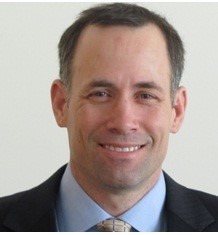
Daniel A. Petalas Daniel A. Petalas was the Commission's Acting General Counsel for a year, after serving as head of the Enforcement Division from February 2012 to August 2015. Before coming to the Commission, he was a Trial Attorney in the Public Integrity Section of the U.S. Department of Justice for nearly 10 years, a Special Assistant U.S. Attorney with the U.S. Attorney's Office for the District of Columbia, and, from 1999 to 2003, a commercial litigation Associate with Vinson & Elkins LLP.
Petalas received a B.A. from California State University—Fullerton, an M.A. in English Literature from Texas A&M University, and his J.D. with Honors from the University of Texas School of Law, where he was the Managing Editor of the Texas Law Review. After law school, he served as a law clerk to the Honorable Thomas M. Reavley on the U.S. Court of Appeals for the Fifth Circuit.
FEC introduces first phase of betaFEC website
The Commission introduced its betaFEC website, providing the public a first look at a redesign that will bring easier access to the agency's data.
-
Van Hollen v. FEC
The U.S. Court of Appeals for the District of Columbia reversed a 2014 district court decision that invalidated a Commission regulation governing the disclosure of certain donations used to fund electioneering communications.
FEC introduces online payment option for administrative fine program
The Commission began accepting online payments for administrative fines.
New disclosure policy for closed enforcement matters and other agency documents
The Commission published a statement of policy that expands the range of publicly available records on the agency's enforcement and administrative functions.
Lisa J. Stevenson serves as Acting General Counsel – present

Lisa J. Stevenson Lisa J. Stevenson joined the Commission in May 2012, serving as Special Counsel to the General Counsel. In October 2012, she was named Deputy General Counsel for Law, where she advised the General Counsel and assisted in overseeing all of the organizational units of the Office of General Counsel, including Policy, Litigation, and Enforcement. Prior to her arrival at the Commission, Ms. Stevenson was a Partner at Zuckerman Spaeder LLP. Before joining Zuckerman Spaeder, she was an Associate with Covington & Burling from 1997 to 2005, and she served as Law Clerk to Honorable Judge James Robertson of the U. S. District Court for the District of Columbia from 1996 to 1997. Ms. Stevenson is a 1992 magna cum laude graduate of Amherst College and she received her law degree from the University of Michigan in 1996.
Revisions to several FEC forms and instructions released
The Commission posted on its website revised versions of several reporting forms and instructions.
-
Republican Party of Louisiana, et al. v. FEC
The U. S. Supreme Court affirmed the three-judge court opinion of the U. S. District Court for the District of Columbia. The district court granted summary judgment to the Commission in a lawsuit that challenged federal campaign finance provisions requiring state and local political parties to use certain types of funds to finance activities in connection with federal elections, including get-out-the-vote, voter registration drives and other communications and activities.
FEC introduces retooled, streamlined, user-centered website

The FEC's retooled 2017 website The Commission introduced its new website, offering improved navigation and an array of intuitive new tools to mine the agency's campaign finance data set.
New versions of FECFile, FEC reporting forms available
The FEC released a new version of FECFile and posted revised versions of several reporting forms on its website.
Online tool helps committees contact their RAD analyst
The Commission launched a web portal that offers political committees a new way to get reporting help from their assigned Campaign Finance Analyst in the FEC's Reports Analysis Division (RAD).
-
New Campaign Guide for Corporations and Labor Organizations published
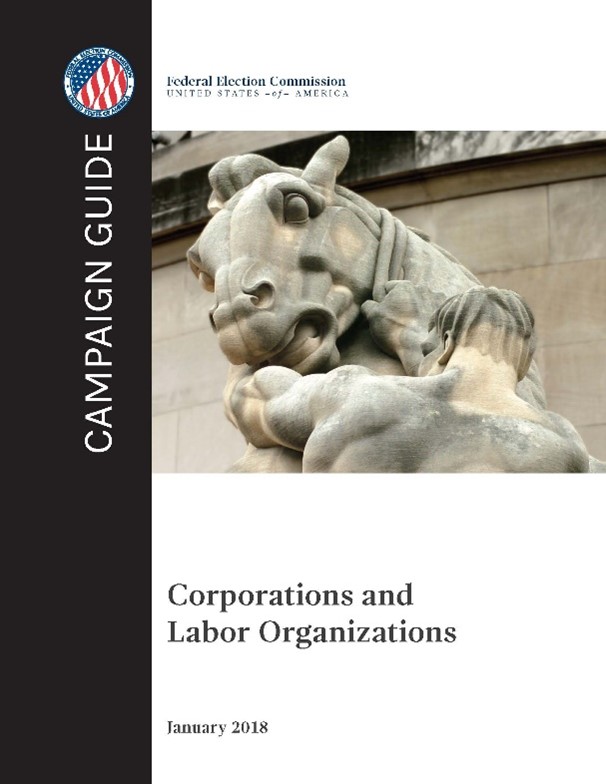
Campaign Guide for Corporations and Labor Organizations The Commission posted on its website an updated Campaign Guide for Corporations and Labor Organizations, which provides an overall summary of the campaign finance laws that apply to corporations, labor organizations, trade associations, and their separate segregated funds (SSFs). The new Guide replaced the 2007 edition.
FEC updates debt settlement and electioneering communications forms
The Commission updated FEC Form 8 (Debt Settlement Plan) and Form 9 (24 Hour Notice of Disbursements/Obligations for Electioneering Communications) and their accompanying instructions.
FEC completes move to new headquarters

The Commission's headquarters building at 1050 First St NE, Washington, DC. The Commission completed its move from 999 E St NW to a new headquarters building at 1050 First St NE, Washington, DC on March 19, 2018.
Public hearing held on internet disclaimers -
The Commission held a public hearing on its Notice of Proposed Rulemaking (NPRM) on internet communication disclaimers and the definition of “public communication.” The Commission received over 165,800 written comments on the NPRM and 18 witnesses testified at the hearing.
Commission begins reviewing dormant committees' use of campaign funds
The Commission began examining the use of campaign funds by dormant committees as part of its review of campaign finance disclosure reports to ensure the activity meets the regulatory standards for permissible use.
Commission regulation governing independent expenditure reporting vacated
The vacatur of the Commission's regulation at 11 CFR 109.10(e)(1)(vi) went into effect after a stay of a district court decision was lifted by the U. S. Supreme Court. This regulation governed reporting by persons (other than political committees) that make independent expenditures aggregating in excess of $250 with respect to a given election in a calendar year. On October 4, 2018, the Commission provided guidance to the public on how to proceed consistent with the district court's decision.
Senate committees begin filing with the FEC and following mandatory e-filing rules
President Trump signed into law legislation which contained a provision that makes the FEC the official point of entry for all Senate filings. The change also subjects Senate filers to the electronic filing requirements that have applied to all other filers since January 1, 2000.
Commission adopts rules for reporting multistate communications
The Commission approved final rules for reporting multistate independent expenditures and electioneering communications made during the presidential primary period. The rules took effect March 31, 2019.
Congress extends administrative fine program to 2023
President Trump signed legislation that officially extends the Commission's Administrative Fine Program for late- and non-filed reports for an additional five years, though December 31, 2023.
-
Court declares regulation on use of federal candidate's name by unauthorized political committees unconstitutional
The U. S. District Court for the District of Columbia declared 11 CFR 102.14(a) unconstitutional and permanently enjoined the Commission from enforcing it.
FEC automates Administrative Fine Program notifications
Notifications to committees regarding administrative fines are now sent via email.
Commission updates rules to implement change in point of entry for Senate filers
The Commission published a notice of interim final rules on the point of entry for FEC reports. The interim final rules eliminate references to the Secretary of the Senate and make clear that the FEC is now the official point of entry for all filings and reports.
Tony Baptiste serves as Acting Inspector General -
Tony Baptiste joined the Commission from the Office of the Inspector General (OIG) at the Commodity Futures Trading Commission, where he had worked since 2000, with a six-month tour in the OIG of the U.S. International Trade Commission.
Christopher L. Skinner serves as Inspector General –

Christopher L. Skinner Christopher L. Skinner was appointed by the Federal Election Commission to serve as the agency's new Inspector General beginning August 5, 2019.
Mr. Skinner came to the FEC with 10 years of Inspector General experience, including conducting investigations, inspections, and internal audits. He has worked as Deputy Inspector General for the Office of Naval Research (ONR) for six years, including a year as Acting Inspector General for the ONR. Prior to that appointment, Mr. Skinner worked as Assistant Chief of Inspections for the Naval Facilities Engineering Command.
-
FEC adjusts report deadlines for elections postponed due to COVID-19 pandemic
As states postponed congressional and presidential primary elections to limit possible COVID-19 exposure, the Commission updated the reporting dates and deadlines associated with those elections.
James E. “Trey” Trainor III (R) serves as Commissioner – present

James E. “Trey” Trainor III James E. “Trey” Trainor III was nominated by President Donald J. Trump and confirmed by the United States Senate on May 19, 2020. He was appointed to a term ending April 30, 2023.
Commissioner Trainor, of Driftwood, Texas, has practiced law for two decades, particularly in the areas of election law, campaign finance law and ethics. He has served as General Counsel to the Texas Secretary of State and Counsel to the Texas House Committee on Regulated Industries, and has represented the Texas Republican Party and two presidential campaigns. Commissioner Trainor has also served on the Advisory Board of the United States Election Assistance Commission. Prior to joining the Commission, Commissioner Trainor was a partner at Akerman, LLP, and had his own private practice.
Commissioner Trainor graduated from Texas A&M University (Corps of Cadets member) in 1997. He was honorably discharged from the U.S. Army Reserves in 2000 and earned his law degree from Texas A&M University School of Law in 2002.
Commission holds first virtual open meeting

The Commission held its first virtual open meeting, meeting by teleconference due to the COVID-19 pandemic, which closed the FEC's offices to visitors and put most staff members on telework status.
Shana M. Broussard (D) serves as Commissioner – present

Commissioner Shana M. Broussard Commissioner Broussard was nominated by President Donald J. Trump and confirmed by the United States Senate by a vote of 92-4 on December 9, 2020, becoming the first African American to serve as an FEC Commissioner. She served as Chair in 2021 and again starting in July 2025.
She is a mission-driven legal and policy strategist with extensive experience in advocacy, regulatory compliance, government affairs, policymaking, operational excellence, and ethical governance. Commissioner Broussard is recognized as a coveted speaker and thought leader on federal campaign finance law.
Commissioner Broussard focuses on building bipartisan consensus and stakeholder engagement. She cultivates cross-party alliances to advance rulemaking and policy reforms, fostering productive collaboration on critical issues in campaign finance. For example, Commissioner Broussard led bipartisan efforts to modernize Federal Election Campaign Act regulations, which improved transparency in digital political advertising by streamlining internet disclaimer rules and resolving an 11-year rulemaking deadlock. She has also advanced bipartisan cooperation to address evolving challenges in campaign finance law, including addressing foreign nationals’ participation in ballot initiatives.
Since serving as a Commissioner, Commissioner Broussard passed regulations with bipartisan consensus that enable candidates and officeholders to use their federal campaign funds for certain security measures, allow candidates to draw salaries from their campaign funds so that every American can run for office, require new disclaimers for communications posted online, and modernize the regulations to reflect technological advancements. She also led a bipartisan effort to publish an interpretative rule about artificial intelligence that confirmed the Commission’s regulations are technology neutral. When she first started as Chair in 2021, she reduced the backlog of enforcement matters accrued when the Commission lost quorum by hundreds of matters in one calendar year. She also significantly improved internal processes by implementing standard procedures for enforcement investigations and enhancing data capabilities that can aid the public’s ability to identify “Scam PACs.” Additionally, Commissioner Broussard reinstated bipartisan legislative recommendations, which resulted in Congress codifying a ten-year expansion of compliance enforcement mechanisms in 2023.
With over 15 years’ experience at the FEC, Commissioner Broussard previously served as Counsel for FEC Commissioner Steven T. Walther from 2015 until her own appointment as Commissioner in 2020. She first joined the Commission in 2008 as an attorney in the Enforcement Division of the Office of General Counsel.
Commissioner Broussard previously was an Attorney Advisor at the Internal Revenue Service, Office of Professional Responsibility, and Deputy Disciplinary Counsel at the Louisiana Attorney Disciplinary Board. She also worked as a New Orleans Assistant District Attorney and was appointed in that role to the Violent Offenders Strike Force.
Commissioner Broussard is a proud alumna of two historically black universities (HBCUs); she earned her B.A. from Dillard University and her J.D. cum laude from Southern University Law Center.
An active member of Delta Sigma Theta Sorority, Inc., Commissioner Broussard has focused on making a positive impact on the Northern Virginia community. Commissioner Broussard served as the Second Vice President of the Northern Virginia Alumnae Chapter of the sorority, Chair of its Health Committee, and Co-Chair of its Risk Management Committee. From 2015-2018, Commissioner Broussard led Project Esther, the chapter’s signature community service event dedicated to empowering women and children on their pathways out of homelessness, domestic violence, and sexual assault. She is also the recipient of the NAACP 2015 Juneteenth Celebration Trailblazer Award for Terrebonne Parish in recognition of her achievement as the first African American attorney from Gibson, Louisiana.
Sean J. Cooksey (R) serves as Commissioner –

Commissioner Sean J. Cooksey Sean J. Cooksey was nominated to the Federal Election Commission by President Donald J. Trump on October 30, 2020, and confirmed by the United States Senate on December 9, 2020.
Prior to his appointment, Mr. Cooksey served as General Counsel to U.S. Senator Josh Hawley, working on the United States Senate Committee on the Judiciary and advising the Senator on issues including constitutional law, judicial nominations, election law, federal criminal law, immigration law, antitrust policy, intellectual property, and ethics compliance. He previously served as Deputy Chief Counsel for U.S. Senator Ted Cruz.
Prior to his Senate service, Mr. Cooksey worked as an attorney at Gibson, Dunn & Crutcher LLP in Washington, D.C., where his practice focused on appeals and constitutional law. He also served as a law clerk for Judge Jerry E. Smith of the United States Court of Appeals for the Fifth Circuit in Houston, Texas.
Mr. Cooksey received his B.A. in economics, summa cum laude, from Truman State University. He received his J.D. from the University of Chicago Law School, where he graduated with High Honors and Order of the Coif, and served as a Managing Editor on the University of Chicago Law Review.
Allen Dickerson (R) serves as Commissioner –
Commissioner Allen Dickerson Allen Dickerson joined the Federal Election Commission on December 18, 2020, following his confirmation by the U.S. Senate. He served as Chairman in 2022 and Vice Chair in 2021.
Prior to his appointment, Dickerson was Legal Director of the Institute for Free Speech (IFS), where he led a nationwide First Amendment litigation practice. While at IFS, he argued more than a dozen appeals, testified regularly before Congress, state legislatures, and regulatory agencies, and was a frequent speaker on campaign finance and political regulation topics. Earlier in his career, he was an associate with Kirkland & Ellis LLP in New York and an attorney for the Republican Governors Association.
Commissioner Dickerson received his undergraduate education at Yale College and his law degree from New York University. In addition to his work with the Commission, he serves as a major in the Judge Advocate General's Corps, U.S. Army Reserve.
-
Commission implements RAD Education Program
The Commission implemented the Reports Analysis Division Education Program which provides an informal, education-based means for resolving compliance issues. The Program provides eligible committees with an opportunity to participate in tailored training focused on the issues identified during the review of the committees' reports and cited in Requests for Additional Information sent during the election cycle, in lieu of a referral for an audit.
Commission hosts first-ever virtual campaign finance conferences - and -
Due to COVID-related travel restrictions for government employees, the Commission converted its planned regional conferences into fully virtual events. During the two-day online training sessions, Commissioners and FEC staff conducted a variety of technical workshops on the federal campaign finance laws affecting federal candidates, political party committees and separate segregated funds.
New Campaign Guide for Congressional Candidates and Committees available
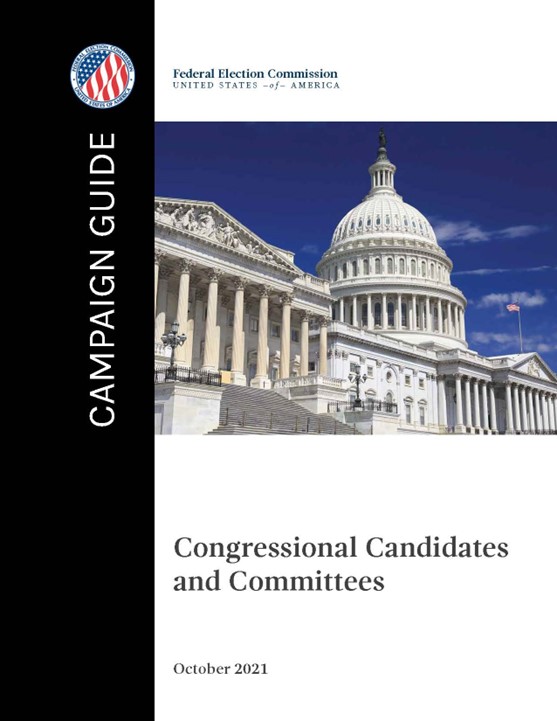
Campaign Guide for Congressional Candidates and Committees The Commission posted on its website an updated Campaign Guide for Congressional Candidates and Committees. The new Guide provides an overall summary of the federal campaign finance laws that apply to candidates for the United States House of Representatives and United States Senate and their campaign committees and replaced the 2014 edition.
-
FEC v. Ted Cruz for Senate, et al.
The U. S. Supreme Court affirmed the District Court's judgment in FEC v. Ted Cruz for Senate that Section 304 of the Bipartisan Campaign Reform Act (BCRA), which limits the repayment of candidate loans, is unconstitutional.
Commission adopts interim final rule on independent expenditure reporting
The Commission approved an interim final rule removing a regulation requiring certain persons making independent expenditures to disclose on their reports the identification of each person who made a contribution in excess of $200 to the filer “for the purpose of furthering the reported independent expenditure.” The interim final rule was effective September 30, 2022.
Dara Lindenbaum (D) serves as Commissioner – present

Dara Lindenbaum Commissioner Lindenbaum was nominated by President Joseph Biden on February 3, 2022, and confirmed by the U.S. Senate on May 24, 2022.
Prior to her appointment, Commissioner Lindenbaum was a partner at Sandler Reiff Lamb Rosenstein & Birkenstock, P.C. (Sandler Reiff) where she advised candidates, political committees, and organizations on a wide range of laws and regulations, including complying with state and federal campaign finance and election laws. She served as outside general counsel for several organizations and worked with directors, boards, and staff on general business matters, structuring their programs, and navigating the complex legal and compliance landscape.
Before joining Sandler Reiff, Commissioner Lindenbaum was an associate counsel in the Voting Rights Project at the Lawyers' Committee for Civil Rights Under Law, where she focused on election law and voting rights.
Commissioner Lindenbaum received her B.S. from Northeastern University and her J.D. from the George Washington University Law School. She was named a 2019, 2020, and 2021 Rising Star in the District of Columbia edition of Super Lawyers.
Commission adopts interim final rule on repayment of candidate loans
Pursuant to the Supreme Court's decision in FEC v. Ted Cruz for Senate, the Commission removed regulatory restrictions on authorized committees' repayment of candidate personal loans.
Commission adopts final rule on internet communications disclaimers and the definition of public communication
The Commission approved a final rule and explanation and justification revising the definition of “public communication” and the requirements concerning disclaimers on certain public communications placed for a fee on the internet. The regulations clarify how the disclaimer requirements apply to various types of internet communications and allow certain internet communications to display disclaimers through alternative technological means. The final rule took effect on May 1, 2023.
-
Commission holds public hearing on audit procedures for committees that do not receive public funds
The Commission held a public hearing on audit procedures for committees that do not receive public funds. The Commission received six written comments and five witnesses testified at the hearing.
Commission holds hearing on amending candidate salary regulations
The Commission heard testimony from two panels about proposed changes to regulations concerning the use of campaign funds by a principal campaign committee to pay compensation to the candidate.
Commission approves Memorandum of Understanding between the FEC and Department of Justice
The Commission approved a Memorandum of Understanding (MOU) between the Federal Election Commission and the U. S. Department of Justice (DOJ) to promote the enforcement of the federal campaign finance laws. The MOU establishes guidelines for the Commission and DOJ to engage in parallel proceedings, share information in appropriate circumstances, and otherwise properly advance the missions of both agencies subject to all relevant legal and ethical constraints informed by the mutual respect of the independence of each agency.
Commission adopts new audit procedures
The Commission adopted new procedures for auditing political committees that do not receive public funds. The new audit process seeks to balance efficiency, procedural protections for audited committees, orderly development of the law, transparency, and the Commission's statutory authority to seek voluntary compliance with the Federal Election Campaign Act. The new procedures took effect for audits that began on or after June 1, 2024.
Commission approves interim final rule regarding contributions in the name of another
The Commission approved an interim final rule that removes the prohibition on “knowingly help[ing] or assist[ing] any person in making a contribution in the name of another.” Making a contribution in the name of another person remains prohibited under 11 CFR 110.4(b). With the removal of 11 CFR 110.4(b)(1)(iii), the existing paragraph (b)(i)(iv) has been redesignated (b)(1)(iii).
This amendment implements the 2018 order of the U.S. District Court in FEC v. Swallow, which declared that regulatory provision unlawful and ordered it stricken from the Code of Federal Regulations.
The effective date of the interim final rule was August 5, 2023.
Commission adopts new agency procedure related to certain litigation
The Commission adopted a new agency procedure related to litigation brought against the Commission for dismissing or failing to act on an administrative complaint. The new procedure provides that the Commission will vote within 45 days of the service of such suit whether it will defend the action. Regardless of the outcome of the vote, the vote certification will be published on the Commission's website, subject to appropriate redactions, as quickly as practicable.
Commission hosts in-person seminars at FEC headquarters in lieu of regional conferences and
Budget constraints forced the Commission to replace its regional conferences with a pair of day-long seminars held at its Washington, DC headquarters.
Commission approves directive governing investigative procedures
The Commission approved a directive which sets forth how the Office of General Counsel conducts investigations following a reason-to-believe (RTB) finding in an enforcement matter. The directive was to remain in force until June 30, 2025.
Commission approves revised regulations on candidate salaries
The Commission approved a final rule and explanation and justification revising its regulations concerning the use of campaign funds by a candidate's principal campaign committee to pay compensation to the candidate. These revisions changed:
- The criteria for determining a candidate's eligibility to receive compensation from campaign funds;
- The maximum amount of compensation a candidate may receive from campaign funds; and
- The period during which a candidate may receive compensation.
Commission updates regulations to address technological advances
The Commission approved final rules modernizing FEC regulations in light of technological advances in communications, recordkeeping, and financial transactions.
The final rules, which went into effect on March 1, 2024, address electronic communications and transactions, such as contributions made using credit cards, by text messages, or through internet-based payment processors. They also revise the regulations to facilitate electronic accounting, recordkeeping, reporting, and redesignation by political committees. Additionally, the revisions eliminate or update references to outmoded technologies.
Congress extends administrative fine program to 2033
President Biden signed legislation that extends the Commission's Administrative Fine Program for late- and non-filed reports through December 31, 2033.
-
Commission streamlines initial stage of enforcement proceedings
The Commission approved a Statement of Policy that simplifies its processing of Matters Under Review at the initial stage of enforcement proceedings.
FEC implements new enforcement case closure procedures
Effective April 2024, the Commission adopted new procedures for the public disclosure of closed enforcement cases. These procedures continued to advance the agency's disclosure mission by providing the public with access to enforcement case documents once the Commission has closed the file, and allowing the maximum time for administrative appeals of the Commission's enforcement decisions.
Commission updates FOIA regulations
As required by the FOIA Improvement Act of 2016, the Commission amended its regulations to change how certain records and documents are made available for public inspection, among other changes relating to FOIA procedures. The interim final rules took effect on July 1, 2024.
New Campaign Guide for Political Party Committees available online
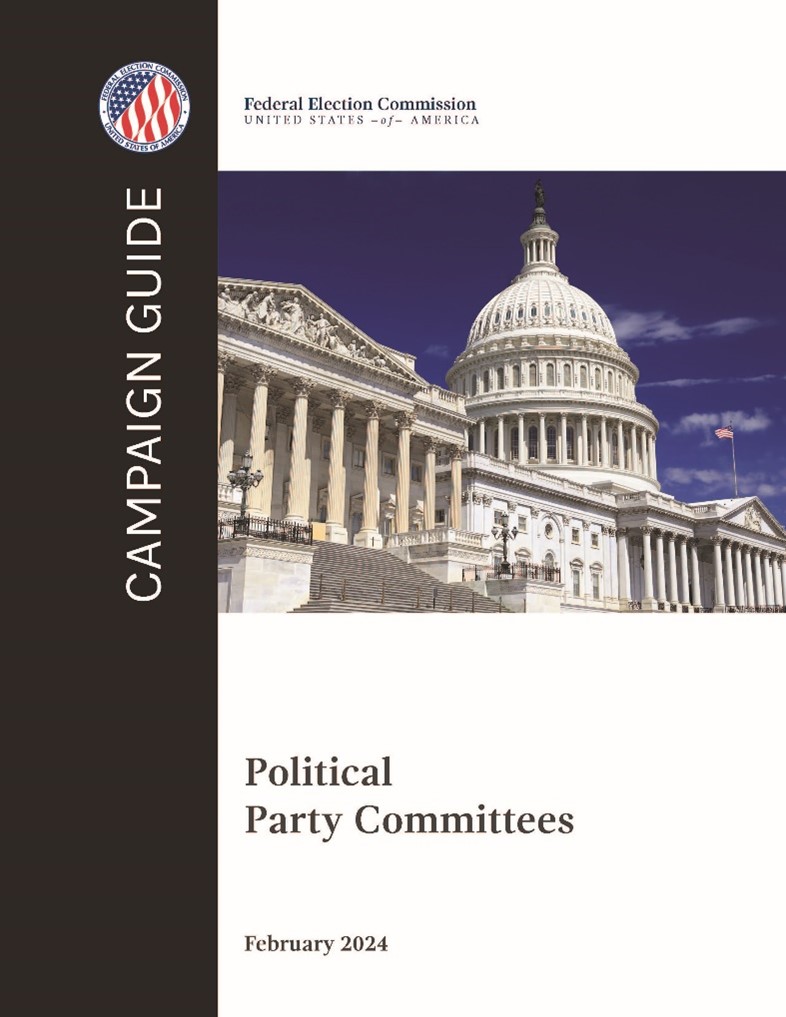
Campaign Guide for Party Committees The Commission posted on its website an updated Campaign Guide for Political Party Committees. The new Guide, which replaces the 2013 edition, was written to help political party committees at all levels - national, state, district and local - comply with the Federal Election Campaign Act and FEC regulations.
FEC receives $8.8 million award to modernize agency's free report filing software
The Commission received an $8.8 million package from the Technology Modernization Fund, a federal funding vehicle formed to support federal agency IT modernization projects. The award will be used to update and improve the FEC's free report filing software program used by more than 9,000 federal political committees to meet their campaign finance disclosure requirements.
Commission approves regulations regarding use of campaign funds for candidate and officeholder security
The Commission approved a final rule and explanation and justification to clarify that federal candidates and officeholders may use campaign funds to pay for security measures so long as the security measures address ongoing dangers or threats that would not exist irrespective of the individual's status or duties as a federal candidate or officeholder. The final rule went into effect on January 1, 2025.
Commission approves Interpretive Rule on artificial intelligence in campaign ads
The Commission adopted an Interpretive Rule to clarify that 52 U.S.C. § 30124 and the implementing regulation at 11 CFR 110.16 apply irrespective of the technology being used to conduct fraudulent misrepresentation. The Commission noted that fraudulent misrepresentation “may be accomplished using AI-assisted media, forged signatures, physically altered documents or media, false statements, or any other means. The statute, and the Commission's implementing regulation, is technology neutral.”
Susan Ruge-Hudson serves as Inspector General – present
Susan Ruge-Hudson The Federal Election Commission appointed Susan Ruge-Hudson as the agency's new Inspector General.
Ms. Ruge-Hudson comes to the Commission with nearly 15 years of experience in the federal government. She has served on leadership teams at the Department of the Interior Office of Inspector General (OIG), Government Publishing Office OIG, and Office of Personnel Management OIG, as well as the Department of Defense's Defense Digital Service.
Prior to her federal service, Ms. Ruge-Hudson worked at private law firms and specialized in corporate and tax law. She holds a B.S. in Politics from Washington & Lee University, a J.D. from Columbia Law School, and an LLM in Taxation from Georgetown University Law Center.
Commission eliminates consolidated reporting on Form 3Z
The Commission voted to eliminate the requirement that the principal campaign committee of a candidate with multiple authorized committees report consolidated information on Form 3Z. The effective date of the final rule was February 1, 2025.
FEC will notify MUR respondents of litigation remands, consider supplemental response or material
The Commission approved a Statement of Policy providing that, if the Commission receives a remand in litigation instituted pursuant to 52 U.S.C. § 30109(a)(8), it will notify the respondent(s) in the Matter Under Review of the relevant court decision(s) and consider any supplemental response or material the respondent(s) may wish to provide.
-
Commission renews directive governing investigative procedures for two years
The Commission voted to renew its November 14, 2023 directive regarding investigative plans for two years, allowing it to remain in force until June 30, 2027. The directive requires the Office of General Counsel to provide the Commission with a proposed investigation plan, in matters where the Commission finds reason to believe, for the Commission's approval. The investigation plan is required to lay out the proposed scope and conduct of the anticipated investigation and, upon approval, governs the conduct of the investigation, subject to modification in light of new information or changed circumstances.